
How to host your own Ride2Work Day
Ride2Work Day is one of Australia’s biggest celebrations of everyday bike riding. Whether you’re a Bicycle User Group, wo...
It’s been 20 years since the tragic death of Amy Gillett, a moment that stopped the Australian riding community in its tracks and ignited a movement for safer roads. Since then, the organisation founded in her memory has evolved into one of the country’s leading national voices for road safety: Amy’s Foundation.
While its name has evolved, its purpose has not. As Managing Director Katey Bates puts it, “Our vision is zero deaths and injuries on the road. We do that through infrastructure, technology, and law, and by improving the relationship between road users. None of that is easy, but it’s essential.”
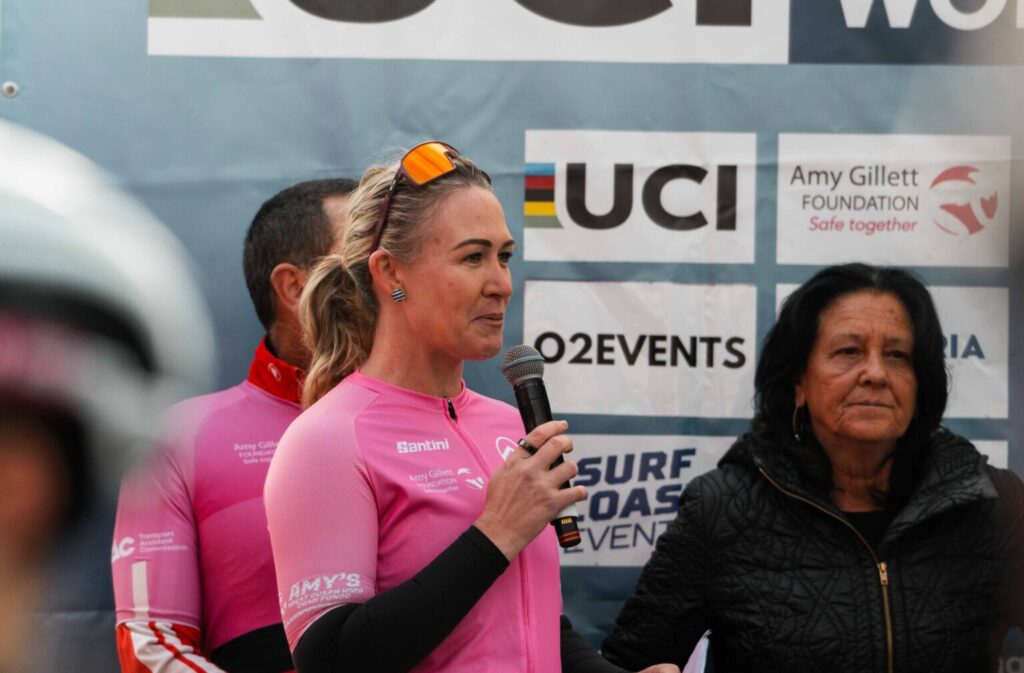
With Queensland’s road toll topping 250 for 2025 at the time of writing, the need to improve road safety, for all users, has never been higher.
Bates, a former professional cyclist and Olympian, brings both lived experience and sharp strategic focus to the role. She speaks with the energy of someone used to attacking from the front of the bunch, yet her thinking is methodical, data-driven and deeply layered.
“Everything we do, we look at through two lenses: what can we change now, and what do we need to work on for generational change?” she says.
Bates is quick to point out that road safety advocacy in Australia is dependent on collaboration, and to that end she recognises the different roles that organisations like Amy’s Foundation and Bicycle Queensland, or other state bodies play.
“Amy’s Foundation is unique because we operate nationally,” she says. “But that means we can’t get into every local or state issue. That’s where the incredible work of advocacy bodies like Bicycle Queensland is so important. A federated system of government needs state-based organisations to drive change on the ground. We can then focus on the national levers – things like technology, enforcement, and legislative reform.”
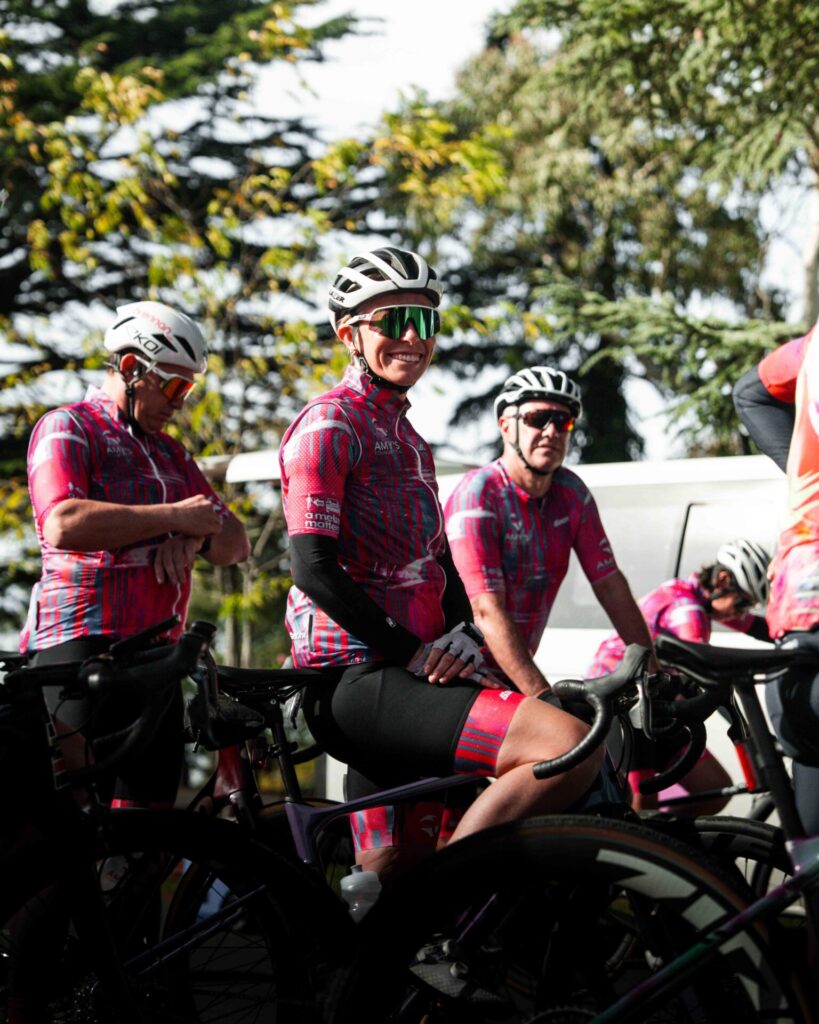
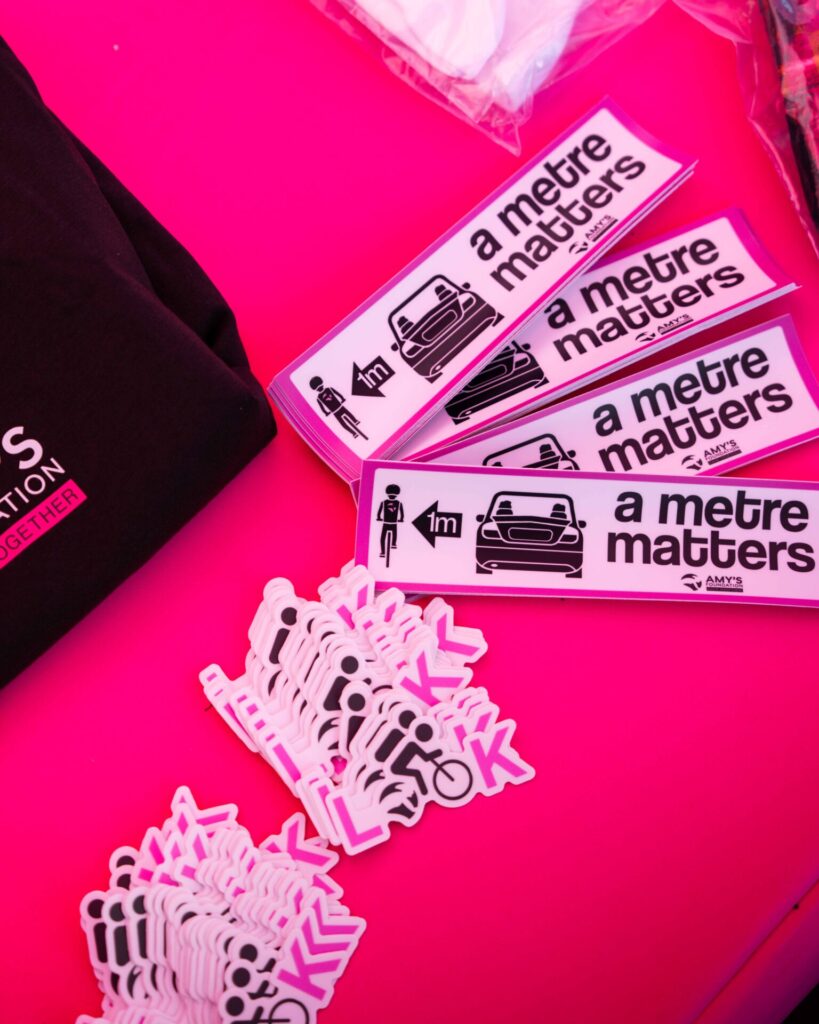
That division of effort gives Amy’s Foundation the flexibility to explore projects that complement rather than duplicate state-level work. For example, Bates points to their involvement in promoting technology that helps protect vulnerable road users. Amy’s Foundation have developed a Car Buyers Guide, designed to equip people with the tools needed to inform their purchase and ask questions about the integrated safety systems that modern cars have.
“Cars today have amazing safety features,” she says. “We’re working with partners to ensure those tools, things like automated emergency braking or cyclist detection, are used to make roads safer for everyone, not just drivers.”
She sees a similar balance between short- and long-term change in their approach to law enforcement. The Foundation’s Metre Matters campaign helped make minimum passing distances law across most of Australia. “That was a huge achievement,” Bates says. “But now we need to make sure it’s enforced. We’re working on ways to make enforcement easier for police, including technology that can record passing distances accurately.”
Anyone who has experienced a close pass but then struggled to find a clear and consistent way to have the issue enforced will understand how important this action on enforcement is. Any of us will automatically get an infringement notice for running a red light or speeding when driving in an area where cameras exist – so why can’t technology be used for similar automated enforcement for close passes on bike riders?
For Bates, the key to sustainable impact is recognising that real change happens at multiple speeds.
“Take car safety,” she explains. “Right now, we can give every driver a car buyer’s guide that explains what to ask for in a safer car. This is a short-term action. But in the longer term, we’re pushing for changes to the Australian Design Rules, so those features become mandatory. That’s when you really shift the needle.”
The same mindset applies to culture. Bates believes that one of the hardest and most important parts of the Foundation’s mission is improving the relationship between all road users.
“It’s getting harder,” she admits. “We’re seeing empathy fatigue. People are tired, distracted and stressed. The result of that plays out on the road. We can’t just ask people to care more; we have to shift what’s socially acceptable.”
That’s where one of her most striking ideas comes in, and it requires a complete cultural shift for the majority of Australians and Australian media. Difficult – yes, but there are examples that Bates highlighted to show it’s not impossible.
“If you really want to know what culture change looks like,” Bates says, “think about how it became unacceptable not to pick up after your dog. Twenty years ago, people didn’t blink if you didn’t. Now, it’s mortifying. You’d never leave it on the grass because you’d be judged for it.”
Her goal is to make cyclist hate equally uncool.
“Right now, it’s still somehow acceptable to mock cyclists – to sell merchandise that’s blatantly anti-cyclist, or to post online about how we ‘don’t belong on the road.’ That has to change. If you scare a rider, if you brag about close-passing, if you put an offensive sticker on your car, it should be seen as completely unacceptable. That’s how we’ll get real, lasting culture change.”
“Imagine if every cyclist in Queensland had just one calm, respectful conversation a year with someone who didn’t understand their perspective,” she says. “That’s thousands of chances to shift attitudes. It doesn’t have to be preachy. It’s about getting people to rethink those little moments.”
The impact of people power can drive incremental change that adds up. “Every time we behave respectfully on the road, every time we model patience or empathy, we’re teaching the next generation. That’s what I see with my kids – they notice how I respond. That’s culture change in action.”
Unlike most advocacy groups, Amy’s Foundation isn’t member-funded. Its supporters include philanthropists and business leaders who are personally invested in road safety.
“That independence gives us a lot of flexibility,” Bates explains. “Our donors aren’t just giving money, they’re giving expertise. The intellectual capital is priceless.”
It’s a model that values ideas and innovation as much as dollars. “Yes, we need to keep the lights on,” Bates says, “but our biggest asset is the calibre of people who believe in what we’re doing. They help us see things differently and sometimes completely outside the advocacy bubble.”
For Bates, that mix of community action, smart policy, and collaboration across sectors is what keeps Amy’s Foundation pushing forward.
“There’s no single solution to road safety,” she says. “We need state bodies like BQ fighting for better infrastructure. We need national organisations like Amy’s working on technology, law, and enforcement. And we need every rider – or every person – modelling respect and empathy on the road.”
And the drive is simple: making roads safer for everyone who uses them.
“Culture change, technology, law – they’re all part of it. But what really matters is remembering that we share the road. Every decision we make, big or small, should start from that.”
Ride2Work Day is one of Australia’s biggest celebrations of everyday bike riding. Whether you’re a Bicycle User Group, wo...
Watt are you torquin\' about? E-bikes and the systems that offer pedal&nb...
For Ellen Beaumont, sport has never been something she dabbled in. It has shaped her identity, her routines, and the way she ...
By Mike Blewitt Ask most cyclists about wet weather gear and they’ll i...