
How to host your own Ride2Work Day
Ride2Work Day is one of Australia’s biggest celebrations of everyday bike riding. Whether you’re a Bicycle User Group, wo...
Riding to work can save money, improve fitness and turn time spent commuting into time spent riding. In 2026, with household costs under pressure, how much does bike commuting actually cost – and how does that compare with getting around by car?
The Australian Automobile Association’s Transport Affordability Index puts the typical Brisbane household’s total transport costs at $458.71 per week in the June quarter of 2026.
If you reacted in shock like we did, it is important to note the AAA model is based on a hypothetical two-car household with two employed adults and includes car loan payments for one vehicle, registration and CTP, insurance, servicing and tyres, fuel, tolls, roadside assistance and public transport.
Your situation would likely be different and it shouldn’t be difficult to tally your own annual registration and insurance costs, alongside averaged fuel, toll, parking and servicing costs. Add car loan payments if required. And public transport if relevant.
That does not mean riding to work suddenly makes every one of those costs disappear. If you keep your car or cars, you will still pay registration and insurance, and you may still be making loan repayments. The savings from replacing car commutes with bike trips are therefore different from the much larger savings available if cycling helps a household avoid owning a second car altogether.
To look at how getting around by bike may save you money, we need to do a few calculations – based on some specific scenarios. Each case will be different depending on if you own a bike for commuting, or have a car loan – or don’t!
If you’re following us here at BQ, chances are you already have a bike. But let’s say you don’t or you want to get a commuter bike. For this example we have used a Specialized Sirrus X 3.0 at $1,150 as a representative, good-quality commuter bike that will take mixed surfaces in its stride. We have allowed another $400 to get set up with a helmet, lights, a lock and basic spares.
We have also allowed $400 each year for two basic services plus wear items such as brake pads, tyres and other consumables. Assuming the bike and initial equipment are spread over five years, the annualised cost of bike commuting is about $710 a year, or $13.65 per week.
The first year costs more because you need to buy the bike and equipment: $1,550 to get set up, plus the $400 annual maintenance allowance, for a first-year total of $1,950.
For a simple worked example, assume a 10 km trip each way, and let’s assume you ride 3 days a week, for 48 working weeks each year. That is 2,880 km of commuting annually.
At that distance, the annualised bike cost works out at about 25 cents per commuting kilometre. It would be less for a longer commute, or if you rode more frequently. And less again if you used your new commuting bike for other short trips.
If you already own a car and continue to keep it, bike commuting does not eliminate every motoring expense. The clearest savings come from using less fuel, reducing distance-related wear and servicing, and avoiding any tolls or parking that would otherwise apply to the commute.
This is the conservative way to think about the savings. The bike costs about $13.65 per week on our annualised model. Against that, every car kilometre avoided reduces fuel use and vehicle wear. For commuters who also pay for parking or tolls, the difference will become substantial very quickly.
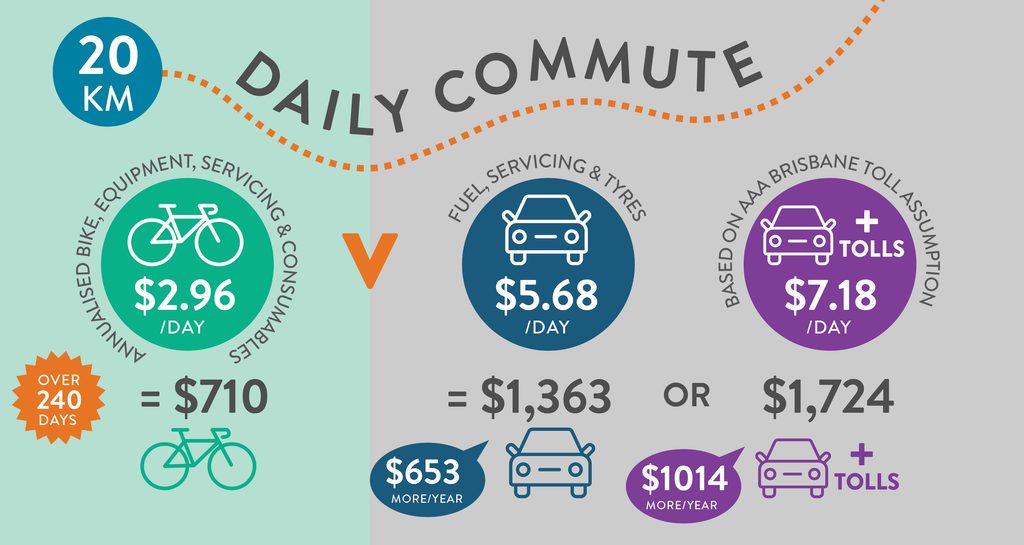
20 KM DAILY COMMUTE
BIKE — $2.96/day
Annualised bike, equipment, servicing and consumables
CAR — $5.68/day
Fuel, servicing and tyres (based on AAA details)
CAR + TOLLS — $7.18/day
Based on the AAA Brisbane toll assumption
Over 240 commuting days, that’s $710 for the bike versus about $1,363 for car running costs,or$1,724 including the AAA toll allowance.
So bike commuting saves roughly $653/year against basic car running costs, or about $1,014/year where the equivalent commute involves the modelled toll cost. This will be dependent on how many days you commute by bike of course.
The bigger financial change comes when riding, public transport and occasional car use allow a household to operate with one car instead of two. In that situation, the avoided costs may include vehicle finance or depreciation, registration and CTP, insurance, roadside assistance and a much larger share of servicing, tyres and fuel.
That is why the real value of bike commuting is not simply the price of petrol you do not buy. For some households, a bike can replace enough car trips that an entire vehicle becomes unnecessary – and that changes the household budget far more than swapping one trip at a time.
Based on the AAA’s 2026 Brisbane household transport model, the costs associated with two cars average around $219 per vehicle each week. Against our annualised commuter-bike cost of just under $14 a week, replacing one household car with a bike could represent an indicative saving of around $206 a week – or more than $10,700 a year.
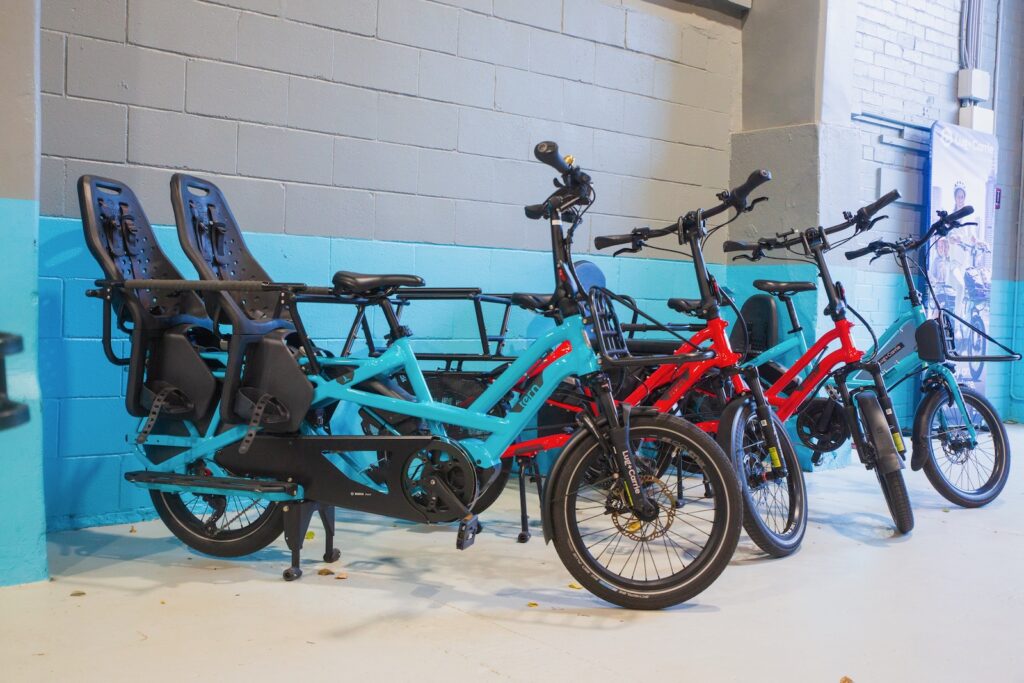
At this point, riders could consider purchasing a cargo e-bike, which may get used for more trips, and therefore provide better value despite the higher entry price. You can even avoid the initial purchase shock and include the servicing with an e-bike subscription via Lug+Carrie.
Let’s say you were able to save even $150 a week on transport by becoming a one car household, you could really get ahead on a home loan. Given the average owner occupier home loan in Queensland is $751,000 with 6.19% interest on a 30-year loan, an extra $150 a week can make a big difference.
If everything else remained the same, it would drop the repayment period from 30 years to 21 years and 9 months – that means you’re paying the home off over 8 years earlier. That’s a saving of about $286,000 over the life of the loan.
Of course, interest rates change and people sell homes as the downsize and upsize. But it bears thinking about what you can do with transport savings.
Everyone’s commute, household and transport needs are different. Your bike may cost less or more, your car may be paid off, and you may have free parking or a daily toll bill. Regardless, the basic calculation is straightforward: work out what your commute really costs now, compare it with the cost of keeping a reliable commuter bike running, and look at which car costs you can genuinely avoid. And think about what other short trips might be possible by bike.
For a rider using the assumptions in this article, a capable commuter bike costs about $13.65 per week when purchase, equipment and maintenance are annualised over five years. And unlike time spent sitting in traffic, those commuting kilometres are also kilometres on the bike, benefitting your physical and mental health.
With escalating costs of living, maybe the best solution is to just ride your bike a bit more? Here at the BQ office we are thinking about the bikes we could justify with a $286,000 saving!
Ride2Work Day is one of Australia’s biggest celebrations of everyday bike riding. Whether you’re a Bicycle User Group, wo...
Watt are you torquin\' about? E-bikes and the systems that offer pedal&nb...
For Ellen Beaumont, sport has never been something she dabbled in. It has shaped her identity, her routines, and the way she ...
By Mike Blewitt Ask most cyclists about wet weather gear and they’ll i...