BQ Meets: Bike Fit Studio

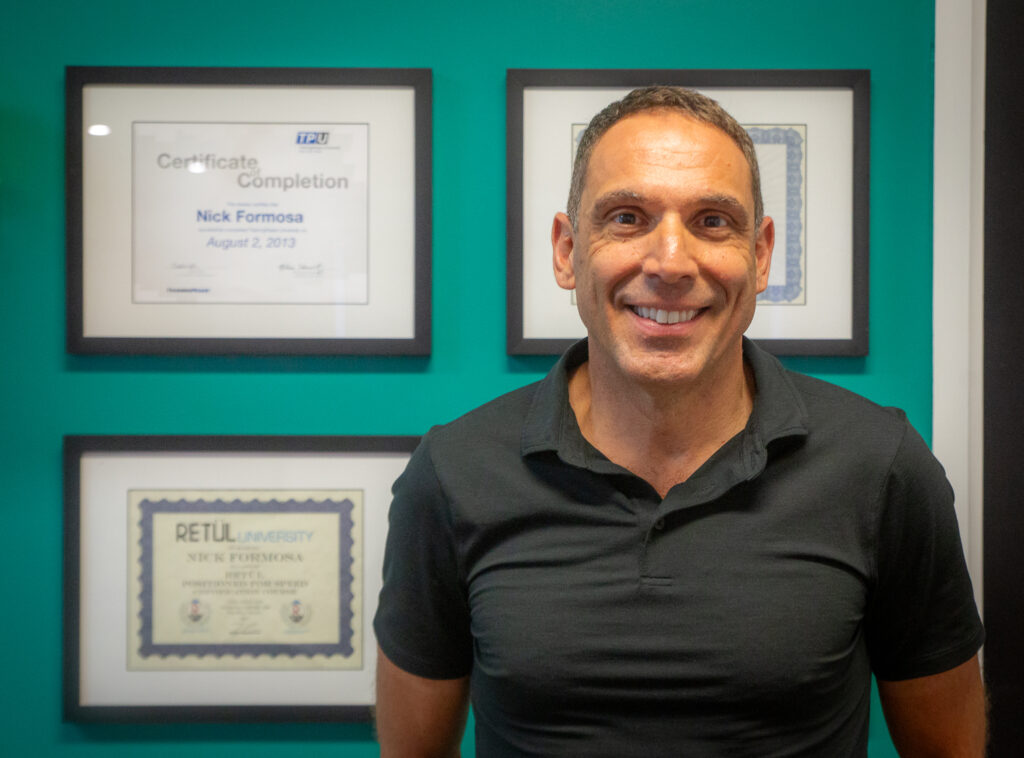
In a custom fit-out studio in Brisbane’s West End, riders of all types are finding their sweet spot – on the saddle. This is Bike Fit Studio, and for founder Nick Formosa, the mission is clear: help people ride in comfort, avoid injury, and make cycling an enduring part of their lives.

Nick’s journey into professional bike fitting started decades before the technology caught up.

“I started working in bike shops in the mid-’80s as a kid – sweeping floors and washing windows,” he says. “Back then, we did basic static fitting in the shop, and I was always intrigued by it. I wanted to get my own fit right, and I liked helping others do the same.”

Fast forward to 2008. After years of coaching and referring people elsewhere for fits, Nick recognised a gap in the Queensland market. “There wasn’t too many people in Queensland actually doing this professionally,” he recalls. “I was sending people away all the time, and there was clearly a need.”
That need wasn’t what he initially expected. “It started out as more of a performance need, to be honest,” Nick says. “But over time I realised the market was predominantly recreational road—people who just wanted to be comfortable on their bike.”

The evolution of the everyday cyclist

The demographic walking through Bike Fit Studio’s door has shifted significantly over time. In the early 1990s, Nick says, most of the cyclists he knew were from the racing or triathlon scenes. Recreational riding simply wasn’t as widespread. With the growth of rides like the MS QLD Brissie to the Bay, the B2GC and of course fondo events around the country.

“Now it’s massive,” he says. “It’s the biggest part of the market.”

He recalls a recent day where three clients came in – an ENT surgeon, a property developer, and a lawyer. “They were all riding for the same reason: a bit of mental health support, stress relief, and physical activity away from their day-to-day lives.”

This rise in recreational riding means more people are discovering that discomfort on the bike isn’t something they have to just put up with. While some still arrive sheepishly, unsure if they’re in the right place, Nick says that mindset is shifting.

“I used to get that question a lot—‘Am I in the right place?’—but not so much anymore. People are starting to understand that a bike fit isn’t just for racers.”
What to expect from a bike fit

A professional bike fit might not be the first thing riders think of when they experience discomfort, but Nick believes it should be.

“You know, some people come in and say they’ve spent the last six months seeing a physiotherapist or doctor because their knee’s been bothering them,” he says. “Then a medical practitioner might refer them to us, and sometimes we pick up things that are actually contributing to the issue—whether it’s saddle position, handlebar reach and height, or cleat position.”

The most common complaints? “Saddle discomfort, neck discomfort, and upper back discomfort,” Nick says without hesitation. “Knees now and then, but mostly it’s the upper body and saddle issues.”
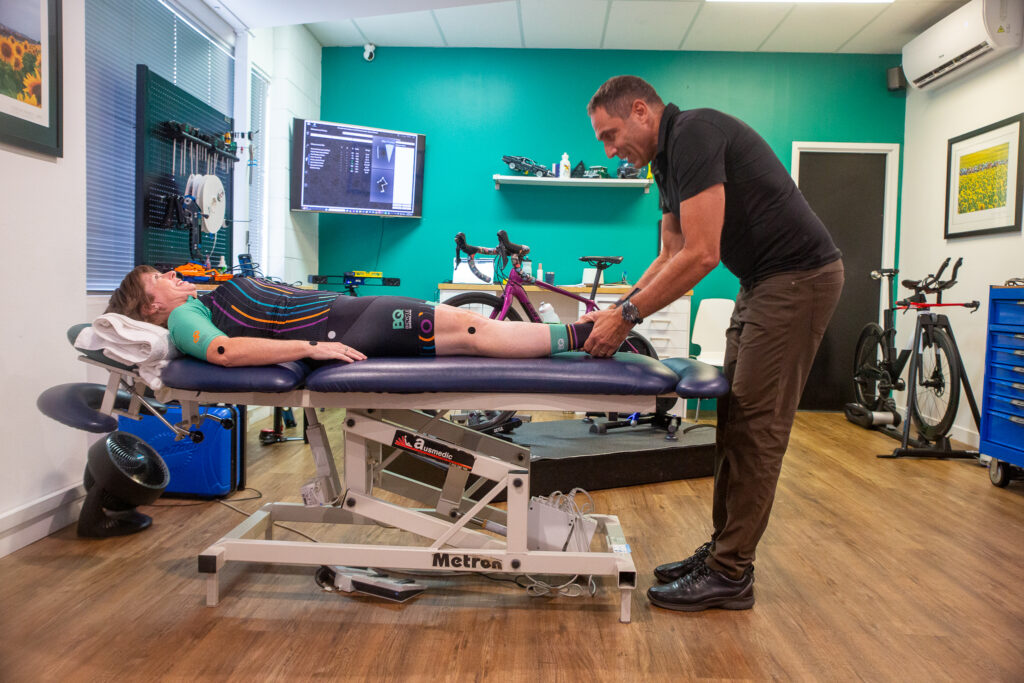
Many of these can stem from poor fit or incorrect bike sizing, but often it’s a combination of both. And while some riders come in without a particular complaint, they often leave with a clearer sense of what a good position feels like.

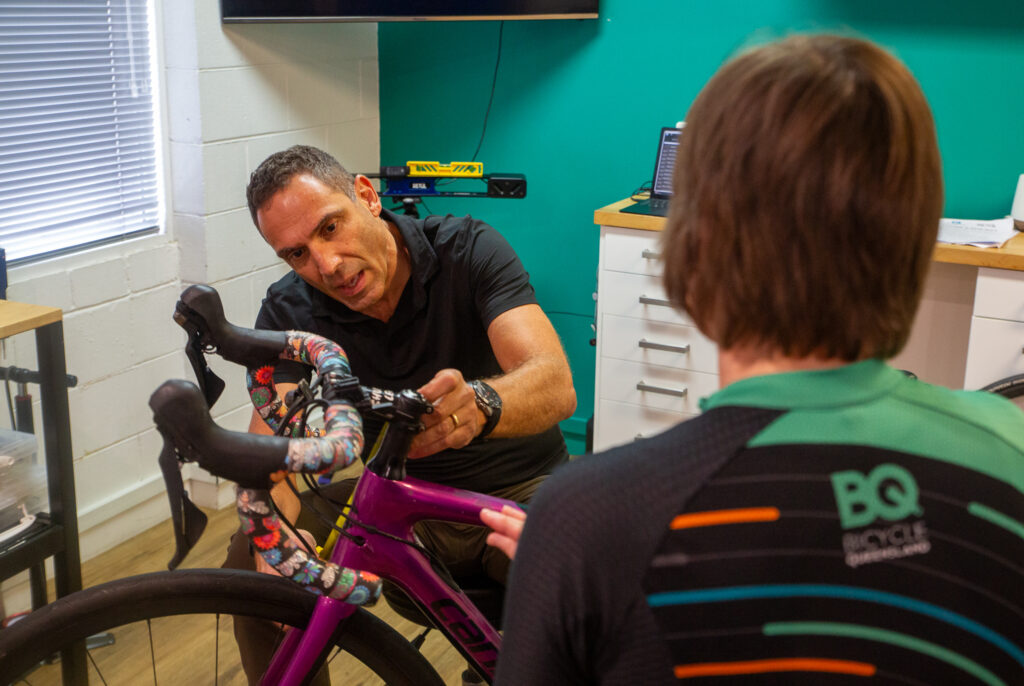
“A bike fit is essentially about understanding what your body can cope with and making decisions around the position to support that,” Nick explains. “We look at the three contact points—the saddle, the feet, the hands—and how pressure is distributed across those.”

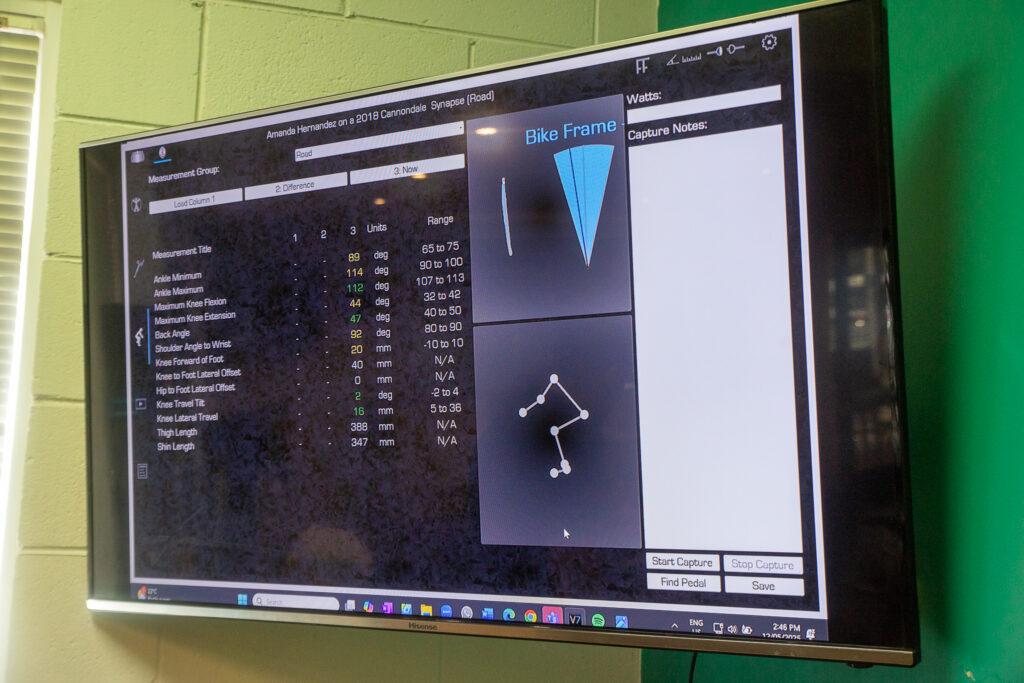
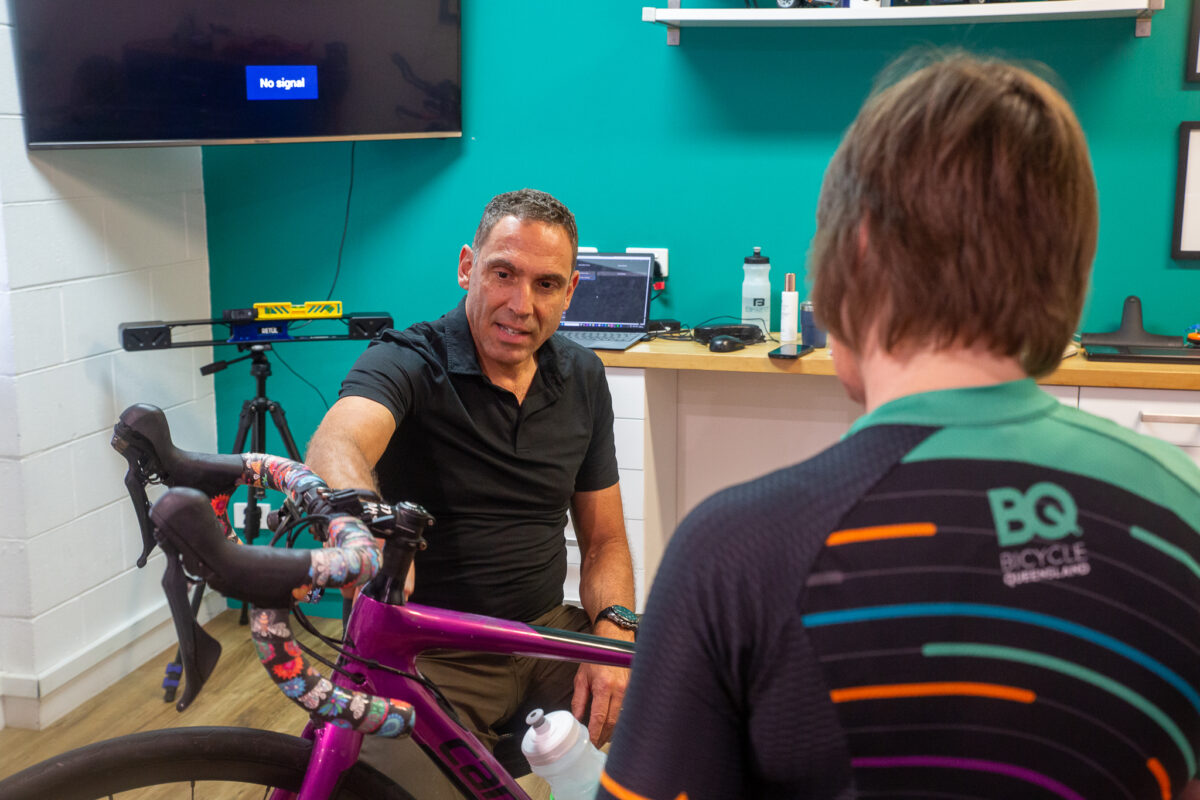
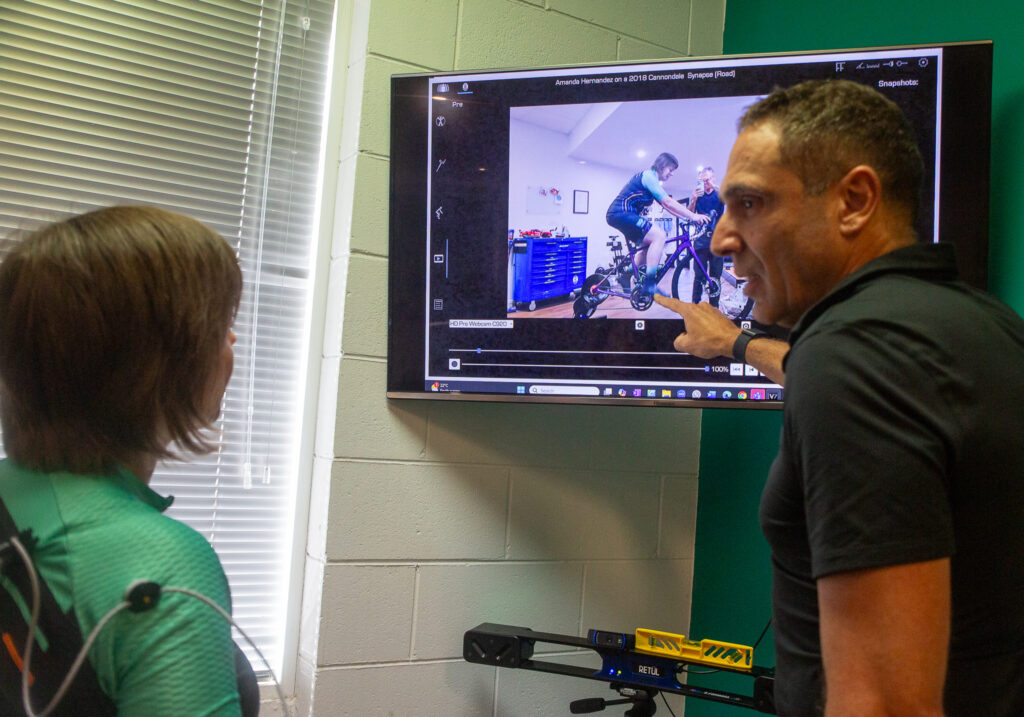
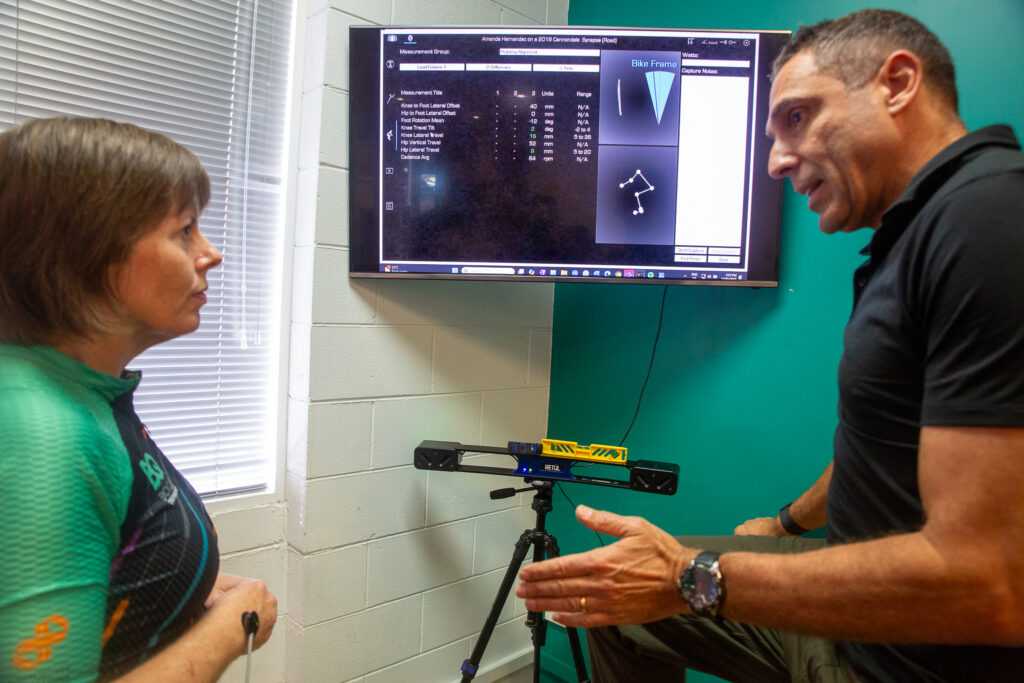
The process is very in-depth. It starts with a range of visual assessments around a rider’s mobility, or any anatomical issues like minor leg discrepencies. Nick uses the Retul fit system, which uses the motion detecting camera and a bunch of smart tech including a tool that looks like Dr Who’s screwdriver to map out your current fit and assess how you fit when pedalling on the bike, including under load. It looks like a mix of art and science – but specific tools and new technology really help to quantify things.
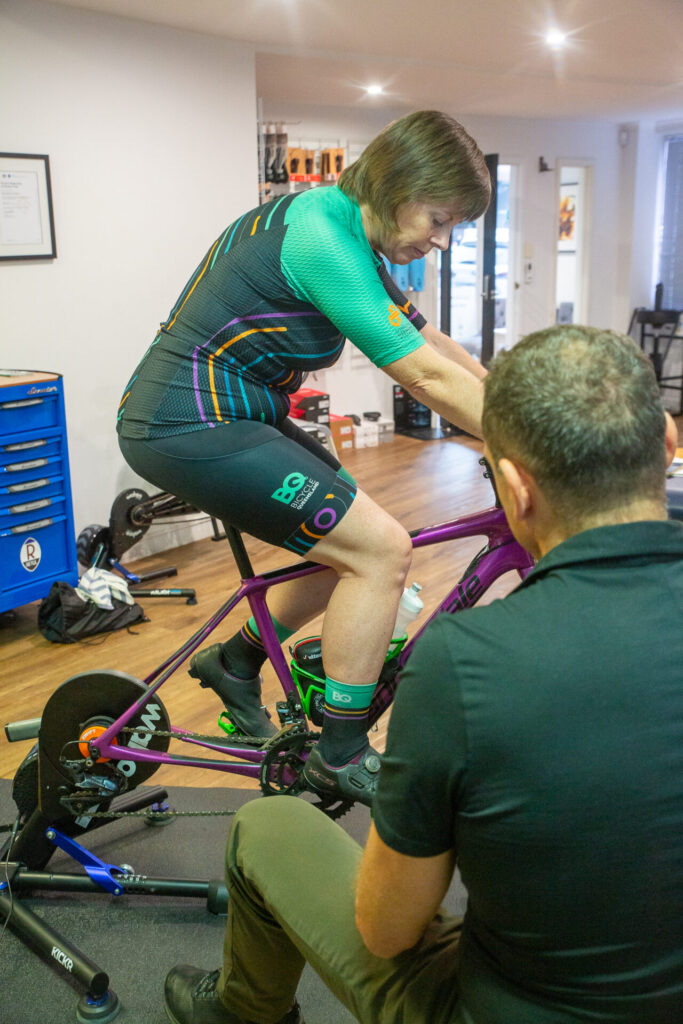
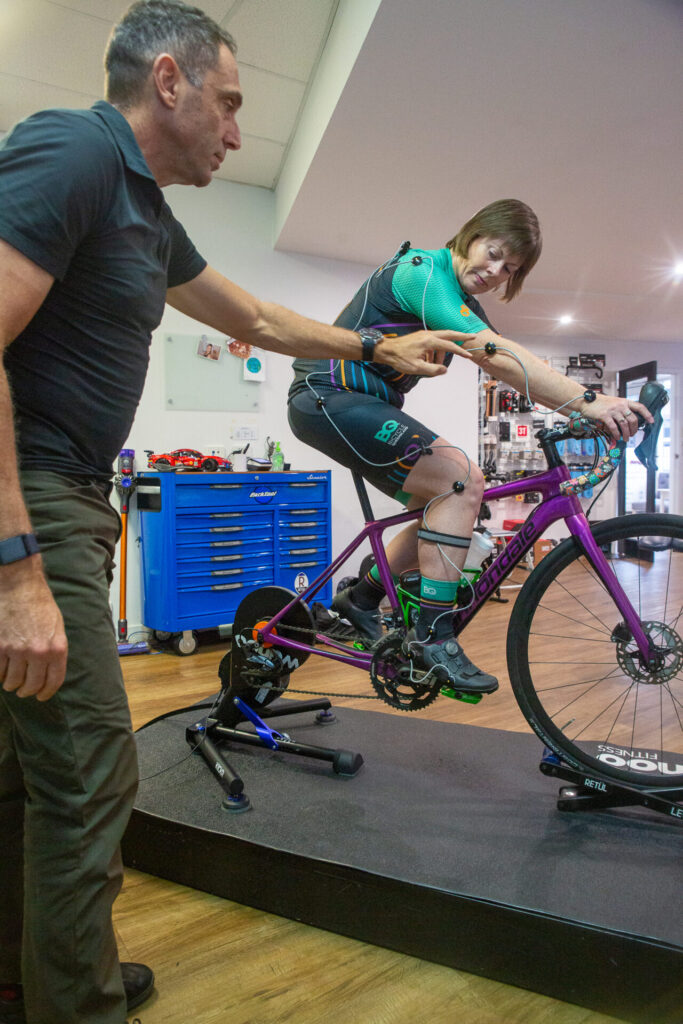
This feeds a lot of data into the system for Nick to analyse. While we see figures on a table, Nick sees signs of incorrect crank length, a stem that may be too long, a saddle that is too high or maybe a case that knee stability has been neglected. This is when the work starts. For a new buyer, Nick can analyse sizing and geometry to get frame size and even the bike choice right. For those with a bike already – the changes begin, as required.
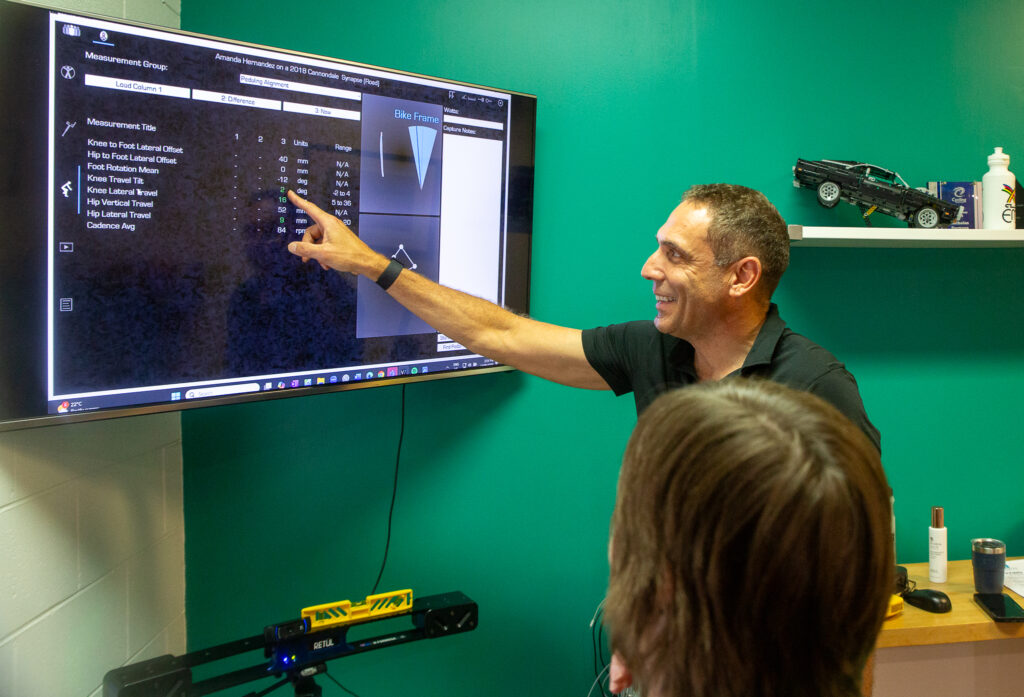
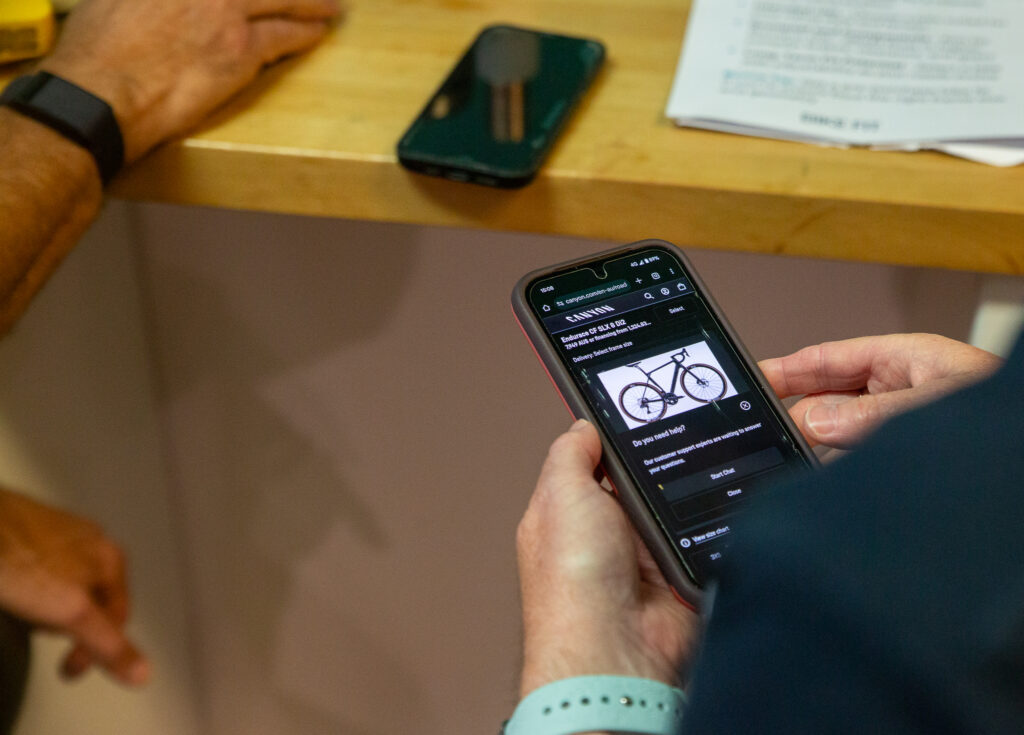
The evolution of a bike fit

A bike fit isn’t a one-and-done process. Nick’s team takes the time to understand how much a rider is using their bike, what their goals are, and how those goals might evolve. For someone riding once a week, the fit prioritises comfort above all. For riders logging four or five sessions weekly, there’s more room to incorporate performance elements.

“Fit definitely evolves over time,” Nick says. “Say someone comes in riding once a week, and then their kids get older, they find more time, they start doing three or four rides a week… suddenly they’re more capable, and their position can shift with them.”

Changes in body composition also play a role. “If someone loses 10 or 15 kilos, their mobility and position on the bike will change. We usually recommend a review fit in cases like that.”

Time-trial and triathlon bikes, in particular, require ongoing tweaks. “Triathletes are always evolving—starting on road bikes, then moving to a time trial bike, and eventually upgrading again,” he says with a laugh. “Some of them are our best customers. They’re always chasing small gains.”
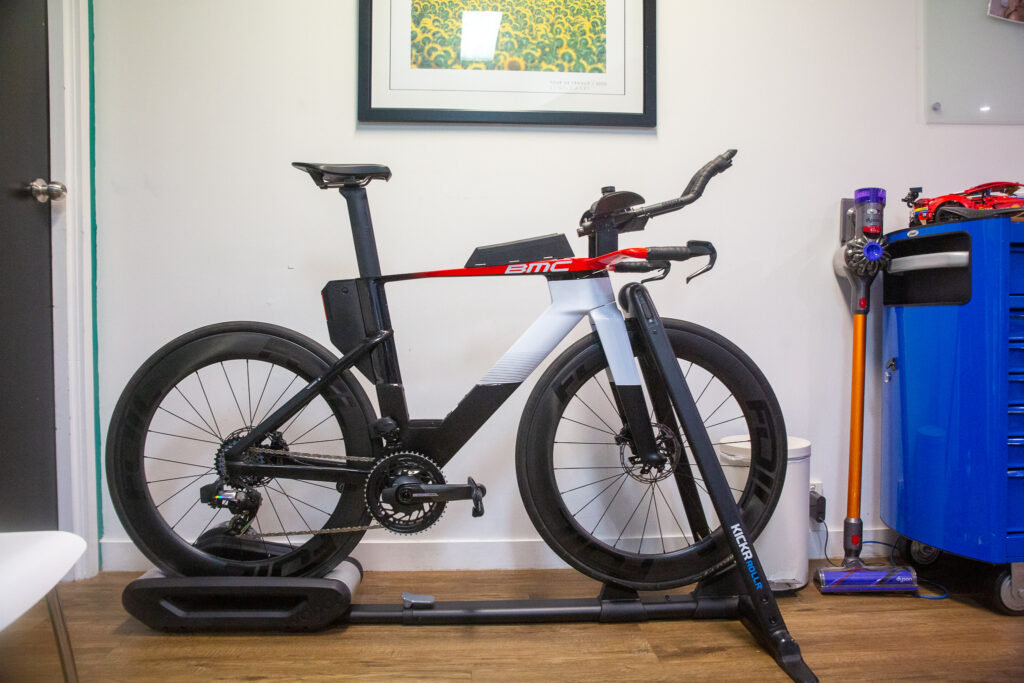
The price of pain-free riding

With a standard road or mountain bike fit starting at around $400, Nick acknowledges it’s an investment—but one that’s minor compared to a new bike or recurring physio appointments.

“We hear it all the time: people spend thousands on a bike, but they’re in pain after 20 minutes,” he says. “For a lot of people, a fit can mean the difference between riding more or letting the bike collect dust.”

Post-fit, riders are encouraged to give their bodies time to adjust. “Typically within two weeks, you should have a good indication of how the changes are working,” Nick says. “We send a follow-up form after five or six rides to see how they’re going.”
That process is key, because riding style, frequency, and goals all shape the ideal fit.

“We’re not trying to make everyone look like a pro. Most of us aren’t racing in the Tour de France,” Nick says. “It’s about finding the right position for where someone is now—and maybe where they want to go.”

The Bike Fit Studio philosophy is simple: comfort leads to consistency, and consistency leads to better outcomes—whether that’s performance, fitness, or just peace of mind.

“If you’re not comfortable at least 85% of the time you’re riding, then you should probably come in,” Nick advises. “Because the goal isn’t just to ride. It’s to enjoy it.”

Visit the Bike Fit Studio website.
What Bicycle Queensland Learned at the 2025 Queensland MTB Forum 

When Bicycle Queensland’s CEO Alton Twine and Director of Advocacy, Andrew Demack, travelled to Cairns for the 2025 Queensland Mountain Bike Forum, it wasn’t just another stop on the advocacy circuit, it was a powerful reminder of how much mountain biking can shape the future of cycling in Queensland. 

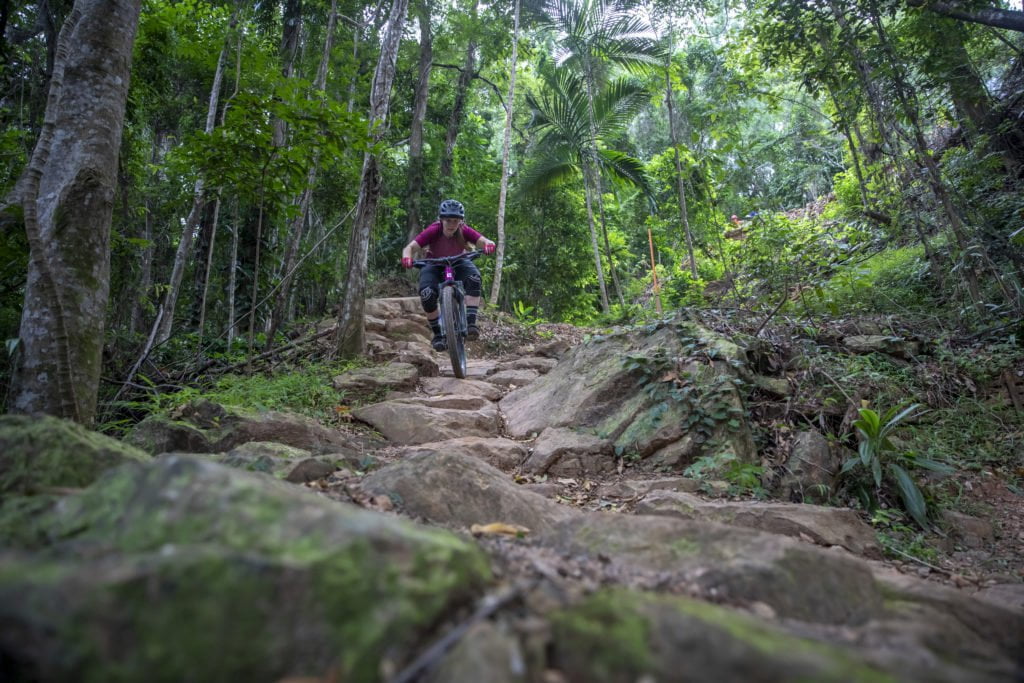
The forum was held between the 2025 UCI Masters World MTB Championships and Crankworx Cairns, two international events that called the Smithfield trail network home in May 2025. Cairns is a spiritual home of Australian mountain biking, with iconic trail features like the Alien Tree, Jacobs Ladder, The Croc Slide and Ronnings Ramp all in the forested hills of the mountain bike park. If you look closely, you’ll even find the Bowl of Death! A dirt bowl that featured in culture creating films like Mud Cows, and even made the 90’s show Pepsi Max Extremists. 

The Queensland Mountain Bike Forum exists to help this growth, bringing together land managers, local government, trail builders, clubs, tourism leaders, and advocacy groups to share what’s working, what needs work, and where the opportunities lie. It was a melting pot of ideas and inspiration — and Bicycle Queensland was there to listen, learn, and connect. 

Source: Tropical North Queensland

Where does mountain biking fit for Bicycle Queensland? 

“Bicycle Queensland attends mountain bike forums and talks to councils and state government about mountain biking,” Andrew explained. “because Bicycle Queensland members are mountain bikers.” 

As a broad church of cycling advocacy, Bicycle Queensland has long championed rail trails, urban infrastructure, commuting routes and safety. Mountain biking has always fit within that but never truly been in the spotlight. However, with more members riding singletrack and more regional communities seeing mountain biking as a path to economic and social growth, it’s clear this part of the cycling world deserves deeper focus from Bicycle Queensland. 

Read Bicycle Queensland’s position on mountain biking in National Parks

“We cover all sorts of cycling and all sorts of cycling people who ride bikes,” said Andrew. “It’s really important that we include mountain biking in our regular advocacy activities simply because that’s one of the things our members do — they ride their mountain bikes… to work, on rail trails, and on purpose-built singletrack across all of Queensland.” 

Learning from leaders, listening to locals 

The forum showcased some of the best minds in the business — including legendary trail builder Glen Jacobs, whose work with World Trail started in Cairns and now spans the globe. World Trail’s evolution is closely matched to that of mountain biking, with a shift from building World Cup tracks to building the mountain bike trail networks that form the foundations of mountain bike destinations, including Blue Derby in Tasmania and Atherton in Far North Queensland. His presentation reinforced how trail networks, when built with vision and purpose, can turn regions into international destinations. And Queensland has quite a number of networks being reimagined or expanded. 

“There’s a real network of networks being developed across Central, North and Far North Queensland,” Andrew noted. “It is pretty exciting to see.” 

But this growing network isn’t just about attracting tourists. It’s about connecting communities, offering youth engagement, and creating healthier regional towns. 

“Mountain biking is actually great for all ages,” Andrew said. “It’s one of those things you can do as you get older that is still really good for you and builds different cycling muscles.” 

He added that mountain biking also helps make more confident, capable riders. 

“Mountain bikers are generally better riders because they’re more aware of their surroundings and what’s going on in front of them on the trail. So if you want to become a better bike rider, get on a mountain bike.” 

Risk, reality and responsibility 

One key discussion point at the forum was the perception of risk. While many councils and land managers are cautious about investing in mountain biking due to assumed danger, the data often tells a different story. 

“Mountain bike risk is often lower than anticipated,” Andrew explained after the forum. There had been some excellent insights from Glen Jacobs on this, given World Trail build trails to reduce forced risk, with how they design trail features. 

“The real challenge is helping stakeholders understand that with good design, education and maintenance, mountain biking can be a safe, sustainable and low-impact recreational option — and one that delivers significant community benefits.” 

Andrew was particularly inspired by stories from communities where trails have become platforms for youth development — with kids not just riding trails, but helping build and maintain them. 

“Young people are engaging with sport, community and responsibility through these trails,” he said. “And in some places, older teens are taking part in supervised trainee programs — working on trail crews three days a week, learning hands-on skills and being part of something bigger.” 

The Mackay opportunity — connecting trail and town 

Among the many points discussed at the forum, Andrew was impressed with how a rail trail project in Tumbarumba in southern NSW ended up driving a project for a mountain bike park – given the increase in tourism and demand. Andrew can see a clear opportunity to use infrastructure to connect to other infrastructure in northern Queensland – using the Pioneer Valley region west of Mackay. 

“There’s huge potential in Mackay,” Andrew said. “The Finch Hatton trails are already gaining attention, and the idea of connecting them to Mackay via the Pioneer Valley Rail Trail is really compelling.” 

Such a link would create not just a destination, but a journey — one that blends singletrack with rail trail, adventure with accessibility. It’s the kind of project that aligns with Bicycle Queensland’s broader vision for integrated active transport and tourism networks. Over $2 billion is spent in Australia on riding tourism activities, but barely 10% of that is spent in Queensland. Such projects would help shift that and move the tourism impact to Queensland’s regions. 

Andrew also noted that these kinds of multi-modal links could encourage new ways of thinking about travel — including combining rail, road trips, and trail riding. 

“Maybe the road trip up the coast is the way to go,” he mused. “There are so many developing networks between Rockhampton and Port Douglas that are all worth a visit — but aren’t destinations in themselves.  

E-bikes, maintenance, and managing growth 

 The growth of mountain bike destinations isn’t without challenges, and e-mountain bikes also had their moment at the forum — both as a growing part of the scene and as a challenge to manage. 

“With an ageing cohort of bike riders, lots of people have taken e-bikes as part of their mountain bike experience and absolutely love it,” Andrew said. “But we were hearing from folks at Finch Hatton that e-bikes can ride up hills in ways that cause trail damage — so that’s an awareness and education piece we need to get right.” 

Andrew was also candid about one of the major takeaways: trail building is only half the job. Maintenance is critical. 

“One of the big learnings of the last couple of years is about maintenance — and making sure when councils step into a project, it’s a whole-of-life project,” he said. “If the project is designed so we just build a set of trails, we’re going to have a big problem — because actually, we’re building and managing a set of trails.” 

He praised some of the newer models being trialed, where local governments and communities partner to train and support ongoing trail crews. 

“There are some good examples coming forward of how it can work — where the local owners put the time and effort into managing the trails. Where that doesn’t happen in Queensland, the trails degrade pretty quickly. We’ve seen examples of that around Southeast Queensland and elsewhere.” 

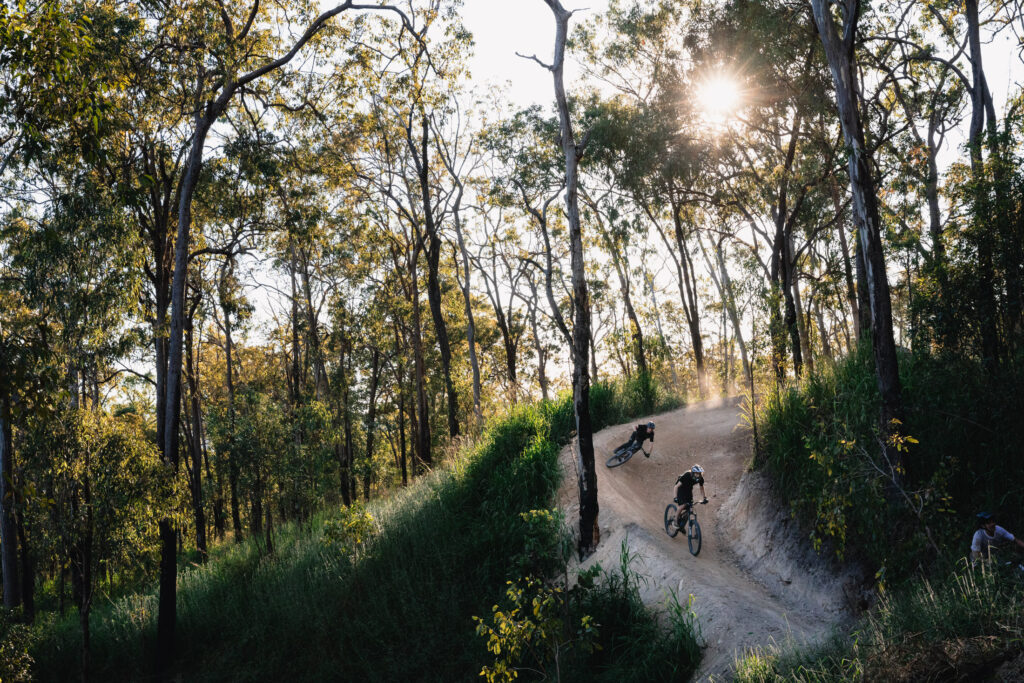
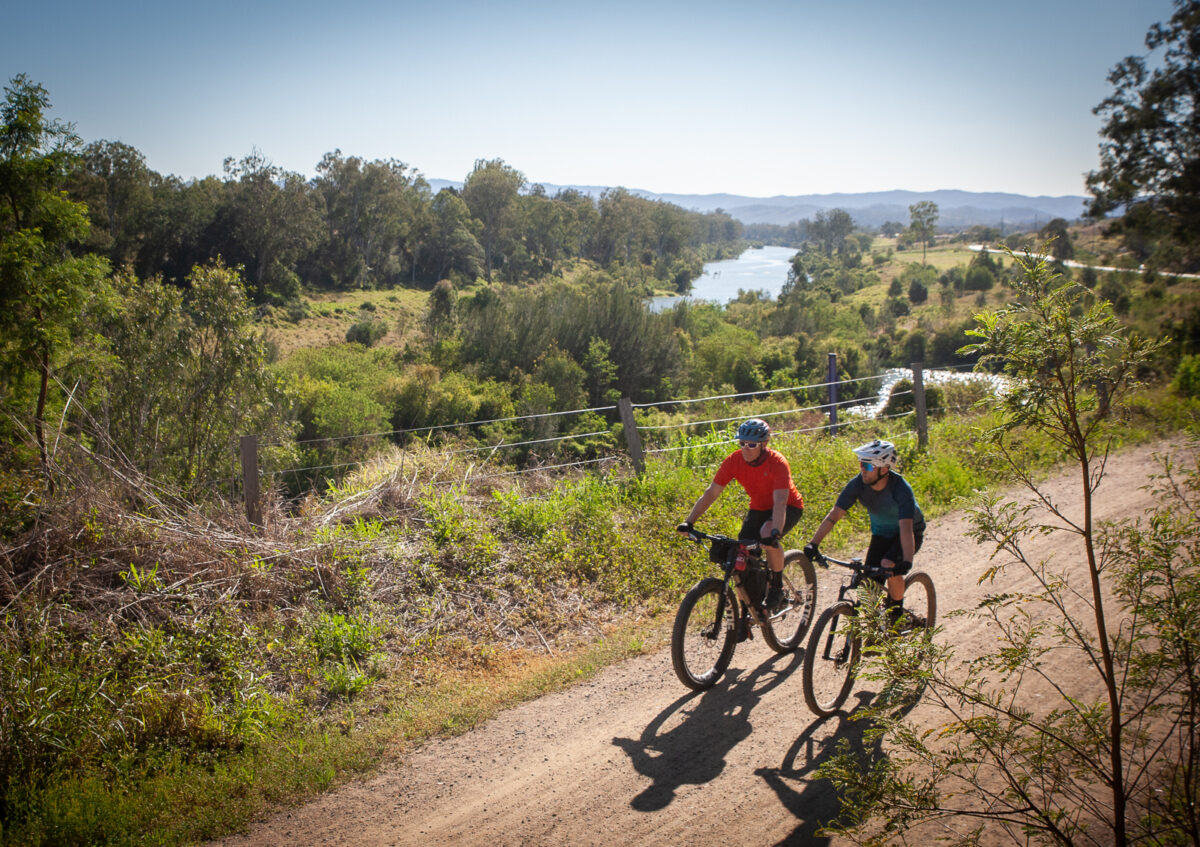
Finch Hatton trails – photo by Flow MTB

Bicycle Queensland’s role: advocate, ally, amplify 

 For Bicycle Queensland, attending the MTB Forum wasn’t just about gathering insights — it was a statement of intent. Mountain biking is continuing to grow and evolve, and BQ intends to be part of its growth. 

“We were there to learn and to listen,” Andrew said. “And to find out more about the current state of play for mountain biking in Queensland.” 

“Part of what Bicycle Queensland needs to be doing going forth is advocating for mountain biking as an activity — as part of the cycling world,” Andrew said. “It’s such a great cycling activity. A good forum like this gets a lot of smart people and passionate people in the room, and as you leave, you’re thinking, ‘Where can I ride my mountain bike tomorrow?’ and ‘What can BQ do to help the growth of mountain biking?’” 

One of the strongest takeaways from the Queensland Mountain Bike Forum was the vital role local councils play in the early stages of trail development. “Getting the local council to have the vision to be part of the development of a trail network is a key step,” said Andrew. 

“What Bicycle Queensland can do is be in the middle of those conversations — there with the local community, supporting their efforts in advocating with council for developing trail networks that are accessible to all people and link to the local communities.” By helping local groups articulate their vision and navigate the planning and funding processes, BQ can play a crucial role in turning great ideas into rideable realities. 

This support is especially important in ensuring that trails deliver long-term social value.  

“Mountain biking brings other aspects to the mix that are super helpful,” Demack added.  

“One of the aspects is getting kids on bikes, and mountain biking is brilliant for that.” Trails close to home give kids and teenagers an active way to engage with sport, community, and personal responsibility — all while having fun. As Andrew often says, it’s all about local trails for local kids. That’s why mountain biking advocacy is a growing and essential focus for Bicycle Queensland, not just in expanding the sport, but in growing cycling culture as a whole. 

As Queensland’s mountain biking culture matures — and as local governments increasingly look to trails as a way to deliver social, health, and economic benefits — BQ’s role as a connector and catalyst will only grow. 

Thank you to Outdoors QLD, FNQROC and Blue Sky Trails for facilitating this forum.

BQ Link: Meet Corry Cycles

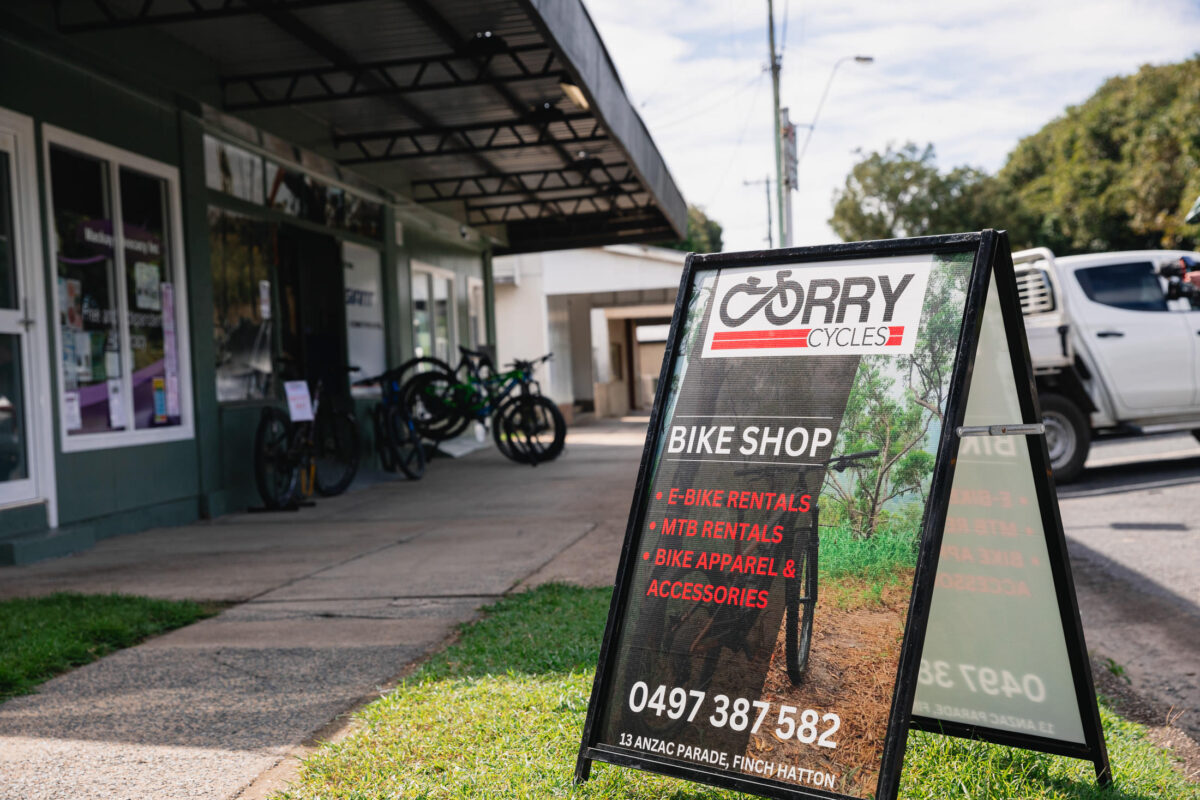
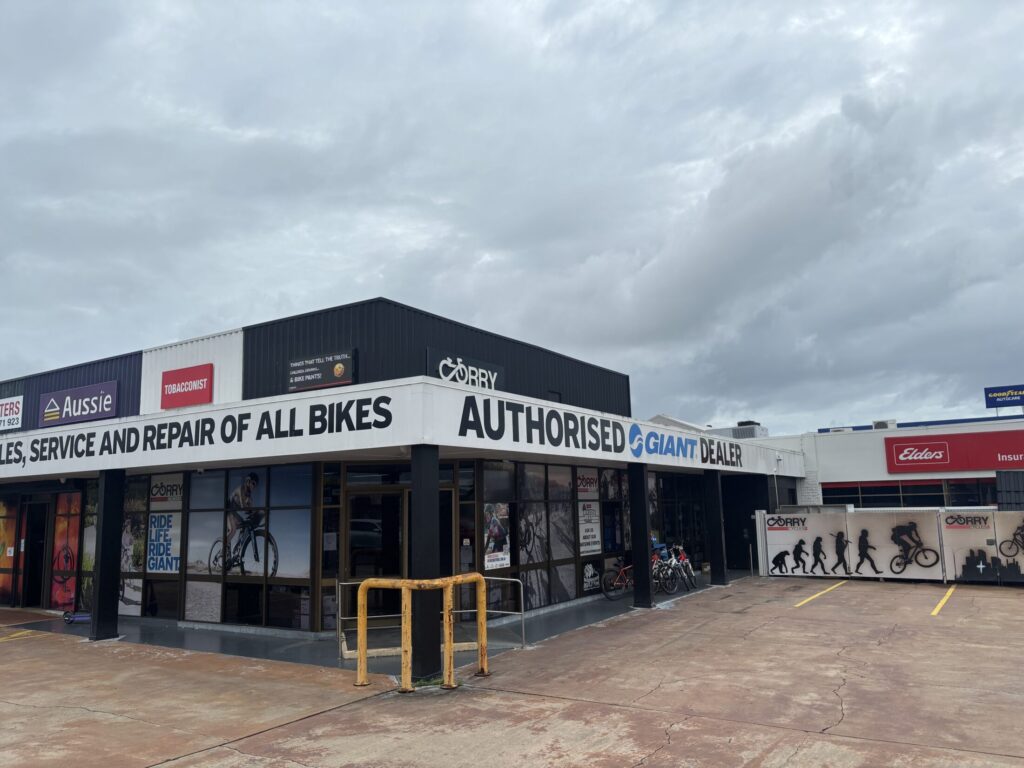
Corry Cycles are a prominent bike shop in Mackay, who have recently set up a second store at Finch Hatton, right at the new Finch Hatton mountain bike park. Both stores are BQ Link retail partners, offering 10% off for Bicycle Queensland members.

We caught up with the owner of the stores Evan Corry, who set up the main shop in 2007. Evan had been studying in Bendigo, Victoria, and racing extensively at the same time. This took him to Belgium for a season as well.

‘But I realised it was easier to sell bikes than to race them. I came back to Mackay and realised there was a massive gap in the local cycling culture. We did have some bike shops around but there were no bunch rides – no cycling community.’

While Evan was a school teacher at the time, he decided it was the time to jump in and open a bike shop. And it was good timing. There was a mining boom, and while the local Holden dealer was Australia’s leading dealer of HSVs, Evan wasn’t far behind as one of Australia’s leading Giant TCR road bike dealers around the same time – or at least that’s what he told us.

‘It was good timing in retrospect. We were really busy with the mining boom – but reality struck with the collapse in 2012. We had to weather the storm’

And weather they did. From small groups who were training for the National Road Series, Mackay developed more of a riding culture over time.

‘In Mackay there’s now about 7 or 8 different bunch rides who all end up at a coffee shop afterwards,  and the range of riders has totally changed.’

Corry Cycles have also backed a number of events in the region over the years including a number of charity rides, which Evan says helped the community see bikes as something for recreation – and not just for sport.

‘We have tried to be involved in the community, at schools and with charity events. So while riding in Mackay did start with a foundation of elite racing it has grown from there.’

One of Evan’s friends introduced mountain biking to the school he worked at, which resulted in an in-depth mountain bike program, and even a pump track built on the school grounds.

With the trail network at Finch Hatton opening about 12 months ago, with two more stages of development in the pipeline for a connected trail network from atop the range at Eungalla and into the valley – there is huge growth for mountain biking in the region. And of course there is scope for a 50km rail trail. Which seems like a lot for a regional town. We had to ask – what makes Mackay so special?

‘Well, you can’t beat our winters!’ laughed Evan.

With the options to head up the range, out to the reef, or enjoy warm sun and cool nights along with typically stable and dry weather, there is a lot to like about winter in northern Queensland.

Finch Hatton trails – photo by Flow MTB

‘Whether you’re a roadie or a mountain biker we have everything on offer, we have every kind of terrain from the hills to the flat, along with the Blue Water Trail for tourists and families.’

When BQ was in Mackay in August, it is clear the region is still growing, with more residential developments being built – which need connections for active transport options.

‘Looking back, we  have seen Mackay come ahead in leaps and bounds. From having nearly zero cycling infrastructure, we now have massive infrastructure developments. The mountain bike club has their own spot at Rowallan Park, there’s Finch Hatton as well and the Blue Water Trail… but we really need to see all that come together.’

‘There are a lot of standalone projects and Mackay really misses the integration opportunities with its cycling infrastructure.’

And that is where Evan hopes Bicycle Queensland can help.

‘Bicycle Queensland have their fingers in just about every pie, so you’re the perfect people to help, with contacts at local and state government. Mackay needs that experience of seeing what works in other areas to give advice around how we maximise any investment and projects here. Maybe we can spend less money and get more, if there is a master plan we can work to that is developed via taking lessons from other places.’


Corry Cycles have two stores, with the store in Finch Hatton specialising in mountain bike hire for the trails at Finch Hatton. If you’re a Bicycle Queensland member, you’ll receive 10% off at Corry Cycles stores, including bike hire.

Photo by Flow MTB

How to build a rail trail

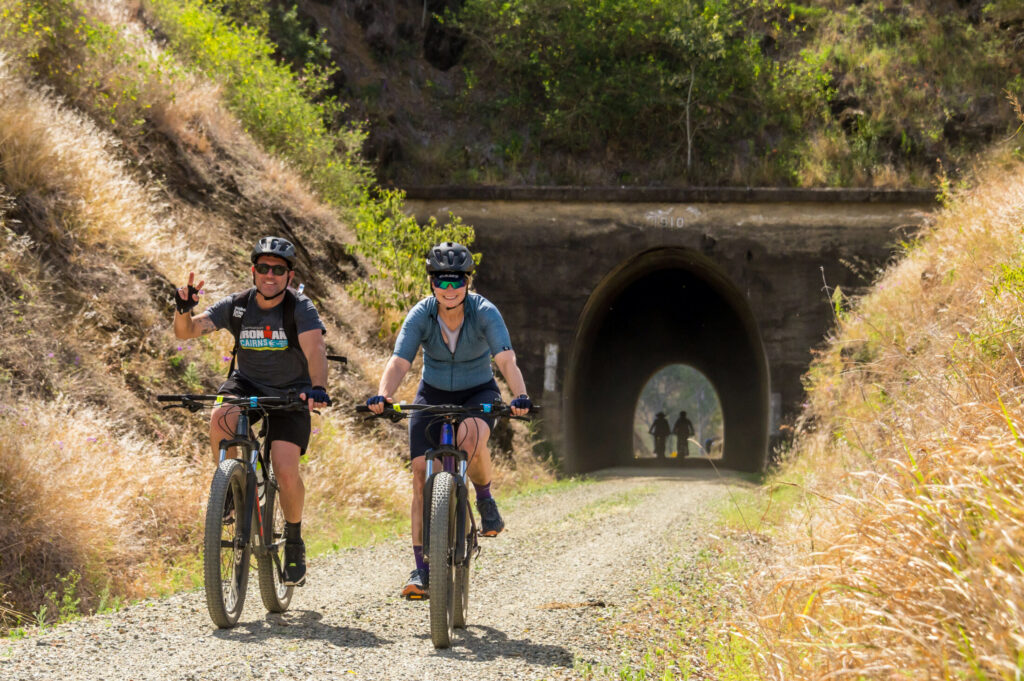
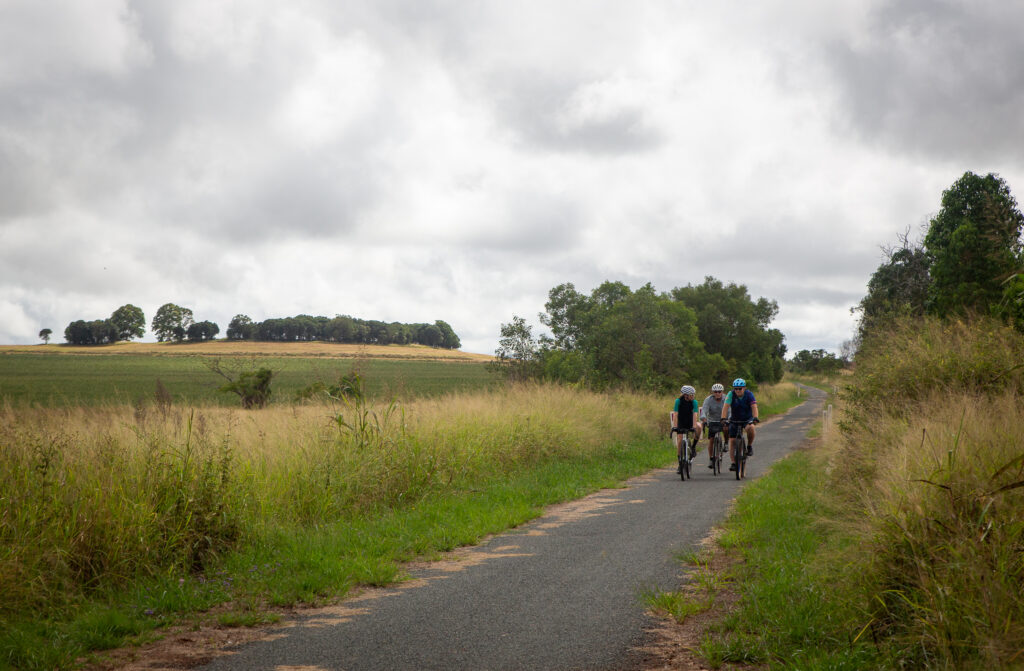
The charm of a rail trail is hard to ignore – gentle gradients that cut a line through the landscape, making hills flater and valleys less deep. They pass through towns with pleasing frequency and often take you through picturesque countryside. And of course – they’re free from motorised traffic. Rail trails can vary around Queensland, changing from sealed pathways that connect schools and suburbs through to rough and ready adventure trails in Queensland’s rural heartland.

But with so many disused rail corridors making a spider web across the state of Queensland – how exactly do you turn a line on a map into a white hot line on a Strava heat map?

In 2024, Bicycle Queensland partnered with Somerset Regional Council for the Rail Trails and Tourism Conference. Hosted at the Somerset Civic Centre in Esk, the two-day conference heard from experts in tourism, marketing, advocacy and economics about the impact that a successful rail trail can have for a region. And then we worked on developing some basic guidelines around what is required to get a rail trail beyond just a good idea, and into a functioning piece of riding infrastructure.

DOWNLOAD: Rail Trail Toolkit Quickstart Guide
DOWNLOAD: Complete Rail Trail Toolkit

Develop a vision for your rail trail

This is an essential step. You need to know what the rail trail is going to do. Will it serve as a useful transport link between communities? Is it a tourism initiative to attract day trip visitors from a 2 hour radius? Is it a multi-day experience to draw visitation from around the state or the country? An idea needs to move to a feasability study and then a master plan – while also assessing any project funding that may be available.

Secure access to a rail corridor

A rail line that is no longer in use is not necessarily a rail trail in the making. The line needs to be decommissioned by Queensland Rail, along with having infrstructure removed. There is extensive stakeholder engagement required at this stage, including determining a suitable model for managing a rail trail, and understanding what the risk looks like, and the potential reward.

All about feasability studies for a rail trail

A feasibility study can determine whether a rail trail project is viable by assessing scope, costs, and potential staging for construction. It provides evidence to support grant applications and ensures informed decision-making. If there’s strong community support for the rail trail, and conversations with landowners and government are underway, a feasibility study might be a useful next step – but can be expensive.

Rail trail planning, design and construction

There is a lot to consider here. What are the biosecurity factors? Hreitage or cultural concerns? What about hazards with existing infrastructure? And how do you plan to maintain what gets built – and what level of surface treatment will suit your budget?

Understanding political engagement and staged construction

Rail trail projects require strong political engagement and a phased approach to development to overcome challenges and secure sustained funding. While their benefits to tourism, recreation, and local economies are well-documented, their success often depends on effective advocacy, securing government support, and maintaining momentum through incremental progress.

Rail trail models of operation

Selecting the optimal model of operation for a rail trail is a complex decision that must balance sustainability, financial viability, community engagement, and quality of experience. Publicly managed trails ensure accountability, while private or hybrid models can introduce efficiency and innovation.

Marketing and events for rail trails

Marketing and events play a crucial role in the success of a rail trail, shaping its identity, attracting users, and fostering community engagement. A well-designed marketing strategy ensures that the trail is positioned effectively to reach key target audiences, while events serve as a means of generating interest, encouraging participation, and providing economic benefits to surrounding communities.

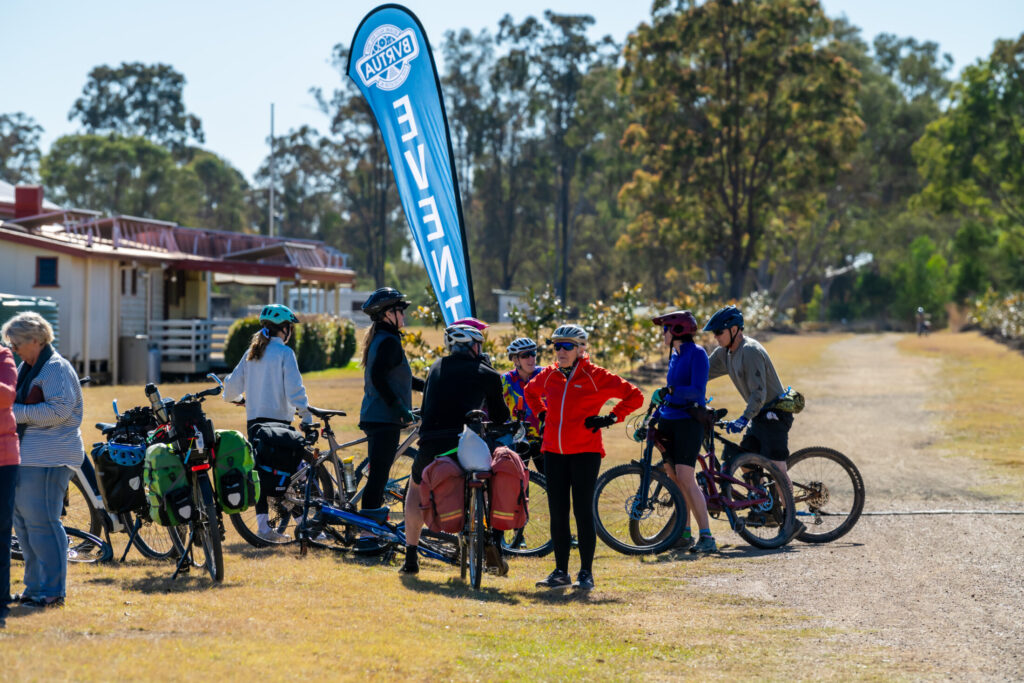
Photo from the 2024 BVRT Festival held by the BVRTUA. Photo by Element Photo and Video Productions.
Bringing a rail trail to life

When planned and implemented effectively, rail trails become far more than just recreational pathways. They serve as economic drivers, attracting tourism and supporting local businesses, while also fostering social connection and healthier, more active lifestyles. They provide safe and accessible spaces for walking, running, bike riding, horse riding, and community events, helping to build a culture of outdoor activity. Their environmental benefits are equally significant, repurposing disused rail corridors into green transport corridors that promote sustainable travel and habitat conservation.

For communities and organisations looking to develop a rail trail, the next steps will depend on where you are in the process. Some groups may be at the early stages, building advocacy and community support, while others may be working through feasibility studies or securing access to a corridor. Others still may be focused on activating an existing trail through events and tourism initiatives. Wherever you are in this journey, Bicycle Queensland is here to support you.

Here at BQ, our team has extensive experience in rail trail advocacy, funding applications, operational planning, and event activation. We can provide guidance on overcoming challenges, building political and community support, and ensuring that your rail trail reaches its full potential. Whether you need strategic advice, practical resources, or connections with industry experts, we are ready to help.

Download our complete Rail Trail Toolkit

Illustrations & Design by indidust.com

All about the Rail Trail Refuge – Linville

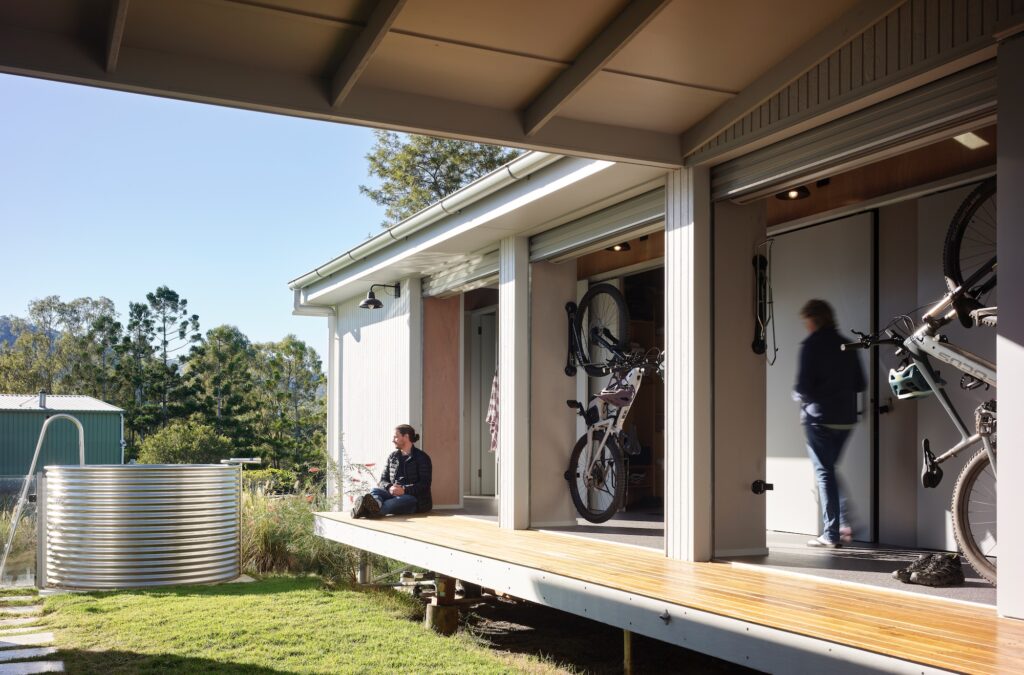
Anyone who has travelled by bike, or with their bike, knows that finding accommodation that is not just welcoming of bike riders, but also suitable, can be challenging. Some regions and indeed some countries are more up to speed with what travelling bike riders may need; secure bike storage, a laundry service or washing machine, maybe some bike tools – and exceptional coffee!

Chevonne Arrowsmith, the owner of the Rail Trail Refuge at Linville, had ridden and travelled extensively while racing bikes and bikepacking, and was convinced that making accommodation suited to bike riders would work.

‘On bikepacking rides I found there isn’t much suitable accommodation. Motels don’t usually like bikes being brought into the room, and self-contained cabins don’t have much room for bikes either. And of course old country pubs can be hard work getting bikes up old staircases!’

Based on these experiences Chevonne felt there was a need for accommodation that worked for bike riders. A stay in New Zealand at a property designed for bike riders and hikers showed what was needed.

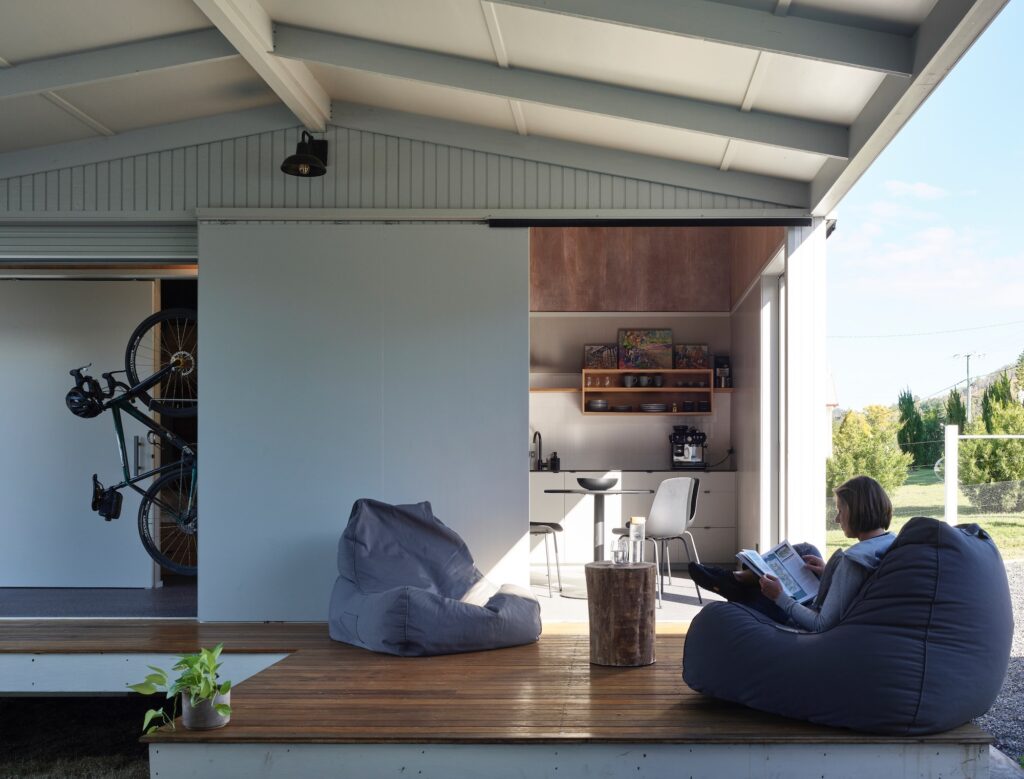
‘You could have a comfy bed, breakfast, a kitchen and bike storage. Everything was there. I like packing light and travelling fast, so the Rail Trail Refuge allows people to do that – we have bedding, linen, a kitchen, breakfast provided and a washing machine.’

With 161km of Brisbane Valley Rail Trail to cover – Chevonne narrowed her location down to Linville.

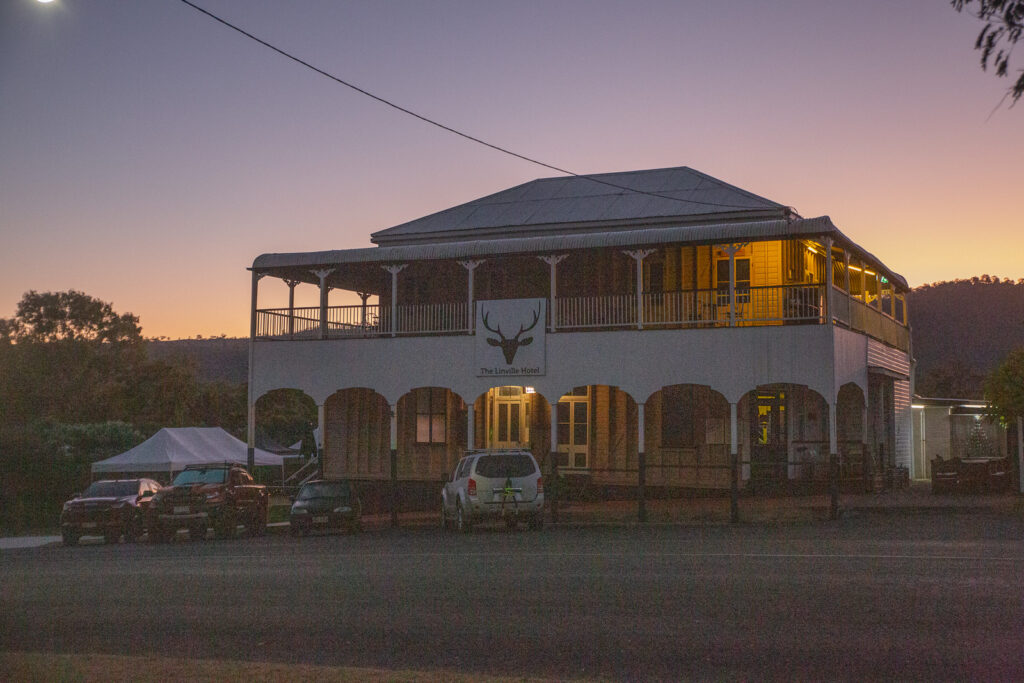
‘I really like Linville as a place to stop on multi-day rides or when doing the Brisbane Valley Rail Trail. I’d often stay at the pub but it can book out pretty quickly as it is popular. So I realised there was a need for some more accommodation in Linville.’

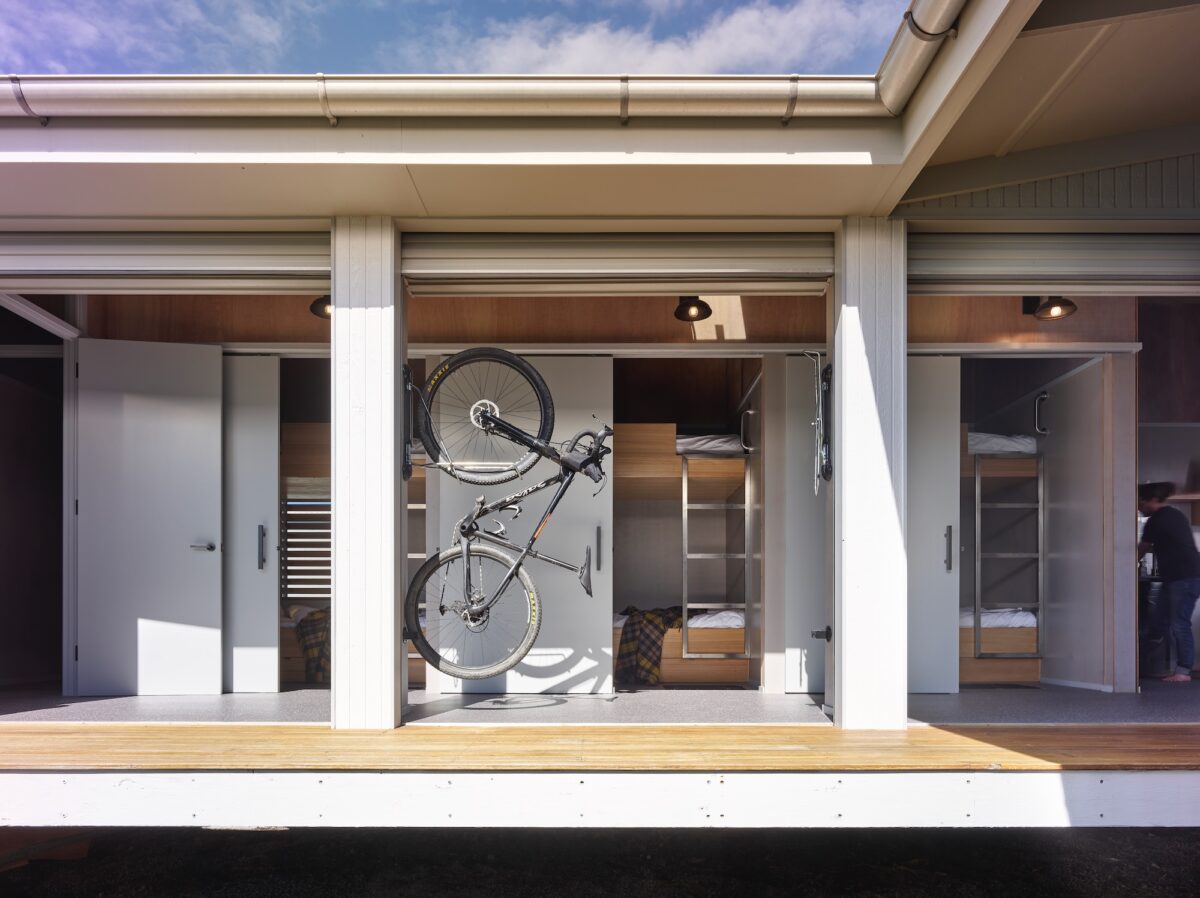
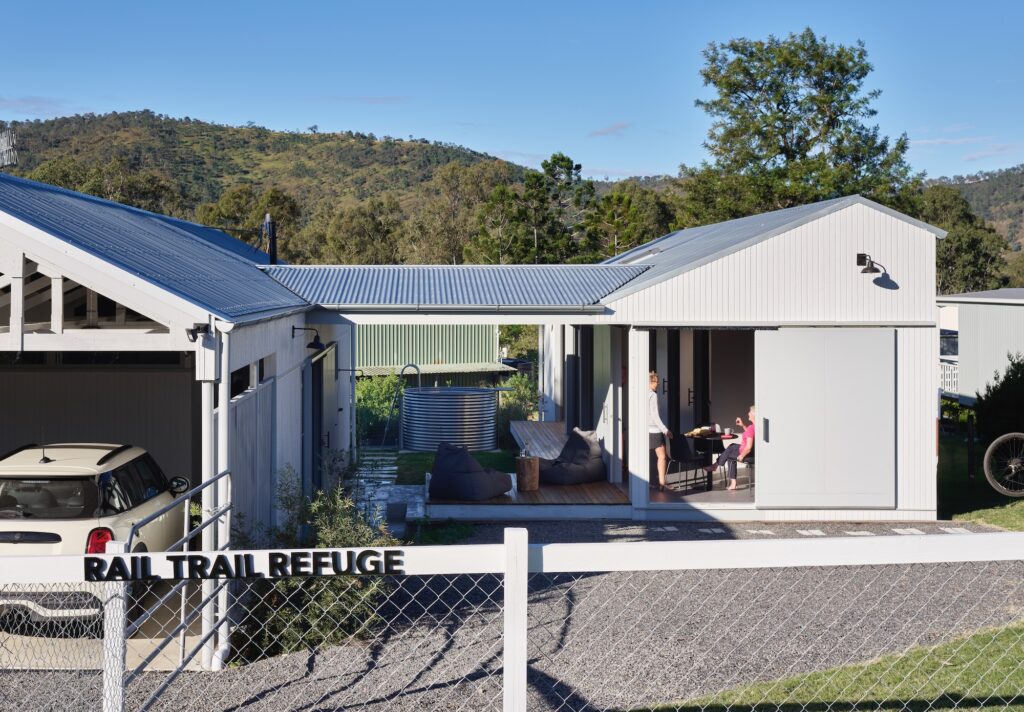
The Rail Trail Refuge was built from the ground up for bike riders. While Chevonne wasn’t sure if they would be able to find land or an existing premises, she worked with an architect on a few concepts, based on what she had sketched out. After securing land around late 2020, they found a local builder, with much of the framing all done onsite given the difficulties getting building supplies at the time. With three rooms, a communal kitchen, chill out area, bike wash and plunge pool… the Rail Trail Refuge was born!

From databases to hosting

With a background in database management, Chevonne started working at Epic Cycles in Paddington when she knew the Rail Trail Refuge was going to proceed.

‘I wanted to get more hands on experience in the bike touring space, which wasn’t really my world at the time. Epic’s customers were a great fit so I got to learn a lot more about touring cyclists.’

‘Our first guests at the Rail Trail Refuge were friends of friends – they had a good stay but I got so much feedback from the first visitors!’

Since then, the Rail Trail Refuge has continued to attract more bike riders, and others keen on active pursuits in the area.

‘About 70% of our guests are staying for one night, usually riding the BVRT from the Yarraman end. I also get a lot of repeat guests, doing sections of the trail or loops from Linville, staying overnight. But I also get bushwalkers, trail runners and bird watchers who stay.’

‘There is a lot to do from Linville for multi-day riding though. Some people ride from Wulkuraka, then do Yarraman return the next day, then ride back to Wulkuraka on the third day, doing an end to end to end with accommodation in the one spot.’

One of the most exciting groups of guests was a group of New Zealanders, who came to stay for about 5 days and wanted some riding suggestions – but not on the rail trail, as they were riding that with friends the following week.

‘I had five different routes in mind and accompanied them. They really enjoyed the variety of landscapes around.’ Chevonne has a wide range of rides listed on the Refuge website – if you’re looking for inspiration, you have to take a look!

The Refuge has been really well received by everyone who stays and Chevonne believes there is scope for more accommodation like it in Linville, or elsewhere on the rail trail, as the area grows in popularity for bike riding.

‘I’d like to see Linville becoming a little biking hot spot. It is already happening a little bit, all along the rail trail. Encouraging people to arrive here by bike does little to interrupt the fabric of a town, but they need to eat and drink. I think it is great for the towns.’


The Rail Trail Refuge, Linville, is a bespoke cycling accommodation provider on the northern end of the Brisbane Valley Rail Trail. Offering accommodation for solo riders or small groups, the Rail Trail Refuge is ideally located on the Rail Trail at Linville, with a kitchen, bike tools, bike washing, laundry, plunge pool, chill out area and much more. The Rail Trail Refuge is the perfect base for a few days exploring this stunning part of Queensland by bike. Bicycle Queensland members can stay three consecutive nights for the price of two between Sunday and Thursday – book directly to secure this saving.

Email: hello@railtrailrefuge.com.au

Ride the Brisbane to Gold Coast Cycle for Cancer

Last year the Mater’s Brisbane to Gold Coast Cycle for Cancer attracted over 5000 riders, taking on a variety of cycling challenges and raising awareness of the essential work that the event supports. Rowan Foster from The Mater had been on course much of the day, and Bicycle Queensland caught up with Rowan soon after midday last year at Southport, when the majority of riders had made it to the finish.

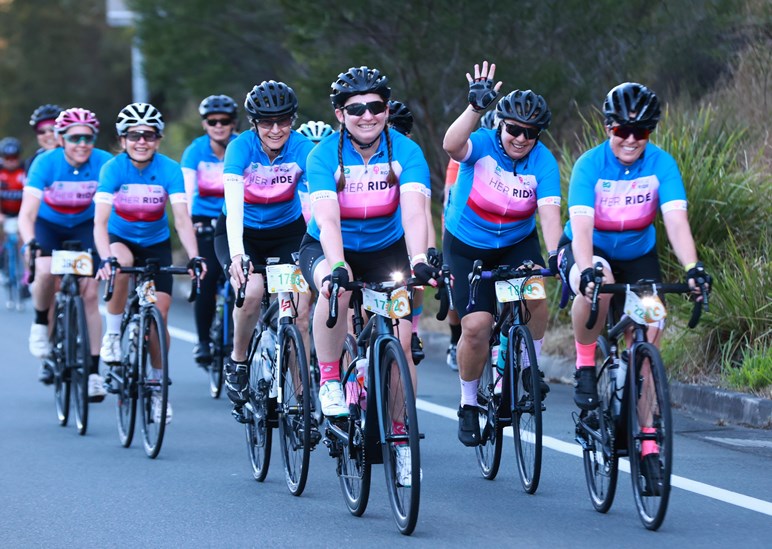
‘The Mater is really delighted with the event this year. With over 5000 riders we raised more than $550 000 to support cancer research. While it started as a wet day the spirits were high amongst the riders, with many smiles and the appreciation of taking on a good challenge by tackling 100km. Of course, it was great to see some blue skies at the finish here in Southport.’

The Brisbane to Gold Coast has had a long history, and now under the direction of The Mater, the event’s legacy is not lost on Rowan – for both the community impact and driving awareness and support of cancer research.

‘This event has really established itself thanks to a long history and the stewardship from Bicycle Queensland. The Mater is really proud to take on the challenge of continuing that success. With over 5000 riders, this event is one of the most popular events in all of Queensland from a mass participation point of view. We’ll continue to provide that opportunity for those who want to take on the cycling challenge but who also want to have a positive community impact as well.’

Those who were part of the ride, or who donated to the fund-raising effort may be asking – just what sort of difference does half a million dollars make for either cancer research or treatment support?


‘The Mater has a really interesting place around this, not only with world-leading cancer research, but also how that transfer works from the bench side to the bedside with our clinical elements in a hospital setting,’ Rowan confirmed. ‘The impact from the fund-raising is really around providing improved treatments for those facing a cancer diagnosis. Chemotherapy can be really brutal and the outcomes can fail. We aim to provide greater hope and the best chance of long term remission for those fighting cancer.’

Here at Bicycle Queensland, the Brisbane to Gold Coast event always offered a way to encourage more people to get out on a bike, to challenge themselves and share that experience with friends. Over the years the impact that made is truly incredible. And the new life with The Mater as the event became the Cycle for Cancer means the impact is even wider.

‘We want to honour the history of the event that Bicycle Queensland have stewarded for so long,’ said Rowan. ‘We’re keen to continue our collaboration with Bicycle Queensland and its members and the wider cycling community to go from strength-to-strength with this event.’

‘The Brisbane to Gold Coast has become a must-do ride for so many people in Queensland,’ stated Bicycle Queensland’s CEO Alton Twine. ‘The popularity of the event is evident right here, as we are surrounded by thousands of people who have taken up the challenge today.’

‘The Brisbane to Gold Coast Cycle for Cancer has really expanded the appeal of the event, as not only do keen bike riders take part, but those who have family and friends impacted by cancer. I am certain that not just the popularity, but the effectiveness of the event as a change for good will grow under The Mater.’

Get your diary out and and lock in October 12 for the 2025 Brisbane to Gold Coast Cycle for Cancer – don’t miss it!

Volunteering with Bicycle Queensland

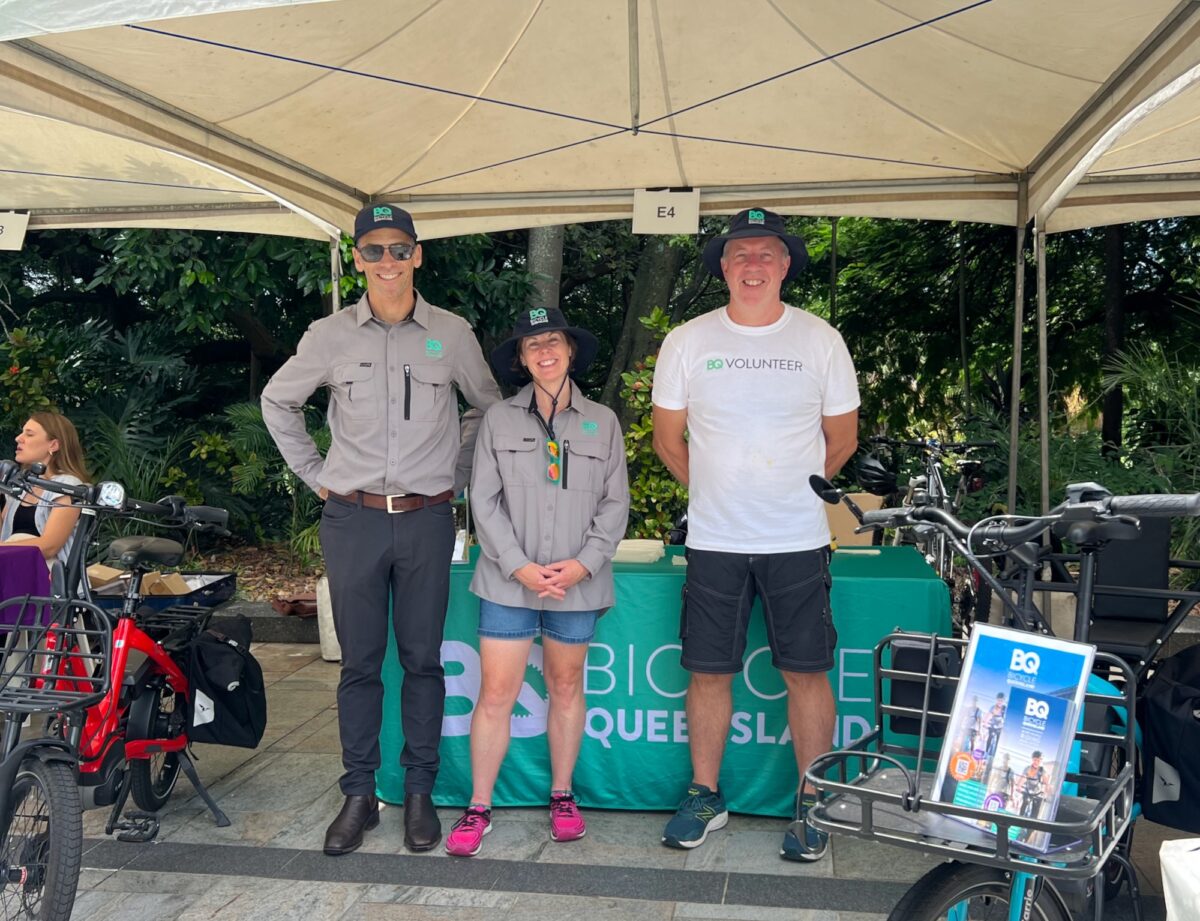
Just like any not for profit organisation, Bicycle Queensland gets a lot of support from our volunteers. Some volunteers have been able to assist year in, year out, helping BIcycle Queensland deliver events or programs around the state. Some volunteers are able to help for a specific event or role in their region or area of interest. Every single one is valuable to our organisation, as we strive to make Queensland a safer and more connected place to ride.

Hans Willemsin lives in Brisbane and has volunteered with Bicycle Queensland in a number of roles, and recently helped out at our Orientation Day stalls that we held at a few universities this year.

  • Why did you sign up to volunteer with BQ? 
    Hans: Volunteering is a chance to contribute to our community. For BQ, I am rather passionate about cycling (even though I know I should do more).
  • What events have you volunteered at – what was it like on the day? 
    Hans: I have volunteered at a couple of uni O-week events. Previously I have helped run e-bike awareness sessions and have helped at a BQ stand next to City Hall for Bike Week.
  • Do you volunteer anywhere else? If so – where abouts and why? 
    Hans: I volunteer for Red Cross, Australian Conservation Foundation and with a local revegetation group. Once again to help our community (Red Cross) and another passion, this time for our environment.
  • Would you encourage other people to volunteer with BQ, and if so, why is that? 
    Hans: Yes, it is a worthwhile activity.

If you would like to volunteer with Bicycle Queensland, head to our Volunteers page to sign up.

All about MS Queensland’s Brissie to the Bay

Multiple sclerosis (MS) is a chronic autoimmune disease that affects the central nervous system, specifically the brain and spinal cord. It occurs when the immune system mistakenly attacks the protective myelin sheath around nerve fibres, causing inflammation and scarring (sclerosis). This disrupts nerve signals, leading to a wide range of symptoms that vary in severity, including fatigue, muscle weakness, vision problems, numbness, coordination difficulties, and cognitive impairment. MS is unpredictable, with symptoms fluctuating over time and potentially leading to disability. While there is no cure, treatments can help manage symptoms and slow disease progression, improving the quality of life for those affected.

MS Queensland have operated for over 65 years, and exists to connect Queenslanders living with neurological conditions to new possibilities and better lives through community, services, support, events, research and neuro wellness initiatives. We recently caught up with Courtney Allen from MS Queensland, to find out more about the charity, their fundraising and of course MS Brissie to the Bay, which celebrates 35 years on Sunday 15 June.

‘The heart of what we do at MS Queensland is providing support and services for people living with MS. We also provide support and services for people with other neurological conditions, including epilepsy, Parkinson’s, dementia and more.’

‘We work with the community to provide a range of services, including the Neuro Assist help line that people can call at any stage of their journey; from when they are first diagnosed or if they are going through a new phase of their diagnosis. This is a help line that their friends, family or carers can use for information or referrals.’

MS Queensland also provides an MS Nurse Advisory service whichprovides one-on-one advice, referrals and information to help with diagnosis, treatment options and concerns.  They even provide individualised housing options and daily living supports for safety, peace of mind and independence.

Like Bicycle Queensland, MS Queensland are involved in advocacy work as well, to spread awareness and understanding of neurological conditions, leading to improvements on how they are diagnosed, treated and supported.

‘We know now that 1 in 4 Queenslanders are living with a neurological condition that causes disconnection from their families and communities, so it is a pretty widespread area of interest – a lot of people are impacted by it. However many services provided by MS Queensland are only possible because of fundraising events like the MS Brissie to the Bay.

The MS Brissie to the Bay is a very popular charity ride, with around 6000 riders taking part each year across the different event distances. Like most charity events, it is not a race and is designed to be suited to a wide variety of riders. Whether that is people wanting to support MS Queensland, or those riding in support of friends or families with neuro conditions.

 ‘It is our flagship event and our largest event that runs in Queensland. Last year we raised almost $1million which was absolutely incredible. It is a great event to be part of.’

MS Queensland have a wide range of other fundraising events, like the MS Moonlight Walk held at Roma St Parklands in October, and of course the MS Readathon, which countless people across the whole of Australia would have taken part in.

So, what does fundraising from the MS Brissie to the Bay support?

‘The fundraising specifically funds the support for people living with MS and neuro conditions that isn’t available by other means. We do have some great services that are thankfully funded by other areas, but some crucial services aren’t. This includes helping people to navigate systems that are confusing to use and helping people with neurological conditions apply for access to the NDIS. The Neuro Assist helpline is also fully funded by the crucial fundraising from the event.’

Besides taking part and fundraising in the MS Brissie to the Bay, there are other ways you can help MS Queensland, as Courtney told us.

‘For anyone wanting to help, sharing awareness and information around the MS Brissie to the Bay ride makes a big difference and highlights the need around why we host this event. For those who can’t ride, they can also come along to the event as part of our Cheer Club. We have a beautiful group of supporters at the end of the ride to cheer all the riders who come across the finish line after completing some epic challenges.

Of course, the other great option is to donate your time as a volunteer. Like any not for profit or charity group, MS Queensland relies on the generous donations of time from volunteers.

‘We have volunteering options from March right through until June, where people can help us in the lead up to the event getting things ready – or they can join us on event day as well, both at the Event Village or out on the course as a marshal.’

‘It is really rewarding being at the finish line at Musgrave Park and seeing so many incredible people there for one goal, to support people living neuro conditions . It is a really special day to be a part of, and there is a lot that you can help with as a volunteer.’


Do you want to volunteer?
Click here.